Choose your operating system to start
Fleet tracking is often introduced as a way to see where vehicles are. A useful fleet management solution does more. It gathers location information, sends it through a communications network, connects it with vehicle information, and presents the results for fleet teams.

We build connected fleet solutions where positioning, communication, software, video, sensors, and management tools work together. Understanding how these components interact can help fleet operators evaluate technology more effectively and choose a system that fits real operating conditions.
The first component is the positioning device. A GPS tracker determines location and can also provide speed, direction, movement status, and route history.
Modern devices may use several satellite positioning systems. Our portfolio includes models supporting GPS, BeiDou, GLONASS, and Galileo, depending on the device. For fleet operators, update frequency, route history, power requirements, deployment options, and remote configuration are more important than a specification viewed in isolation. These factors determine whether the hardware fits daily operations.
A tracker cannot provide useful visibility unless information can reach the management platform. This makes cellular connectivity another core component.
Fleets may operate across highways, cities, rural areas, ports, or industrial sites. The communications module therefore needs to match the deployment environment and expected data volume. Basic location tracking uses relatively little data, while video telematics can require substantially more for live streams and event clips.
We therefore treat connectivity as part of system design rather than an isolated specification. Cellular technology, data plans, device configuration, and transmission methods should be considered together.
Location tells a dispatcher where a vehicle is, but not what it is doing. Vehicle inputs, I/O interfaces, and sensors can add that missing context.
Depending on the application, a telematics device may connect with ignition, door, fuel, temperature, or other vehicle signals. A simple combination illustrates the idea:
GPS location + ignition status + door input = clearer operational event
A geofence alert becomes more useful when associated with vehicle status. A temperature warning also becomes more actionable when managers can identify the vehicle, route, location, and time.
That is why we view fleet management GPS tracking as an operational tool, not simply a map with moving icons.
Hardware creates the data, but software determines how teams use it. A telematics fleet management system should offer more than a map.
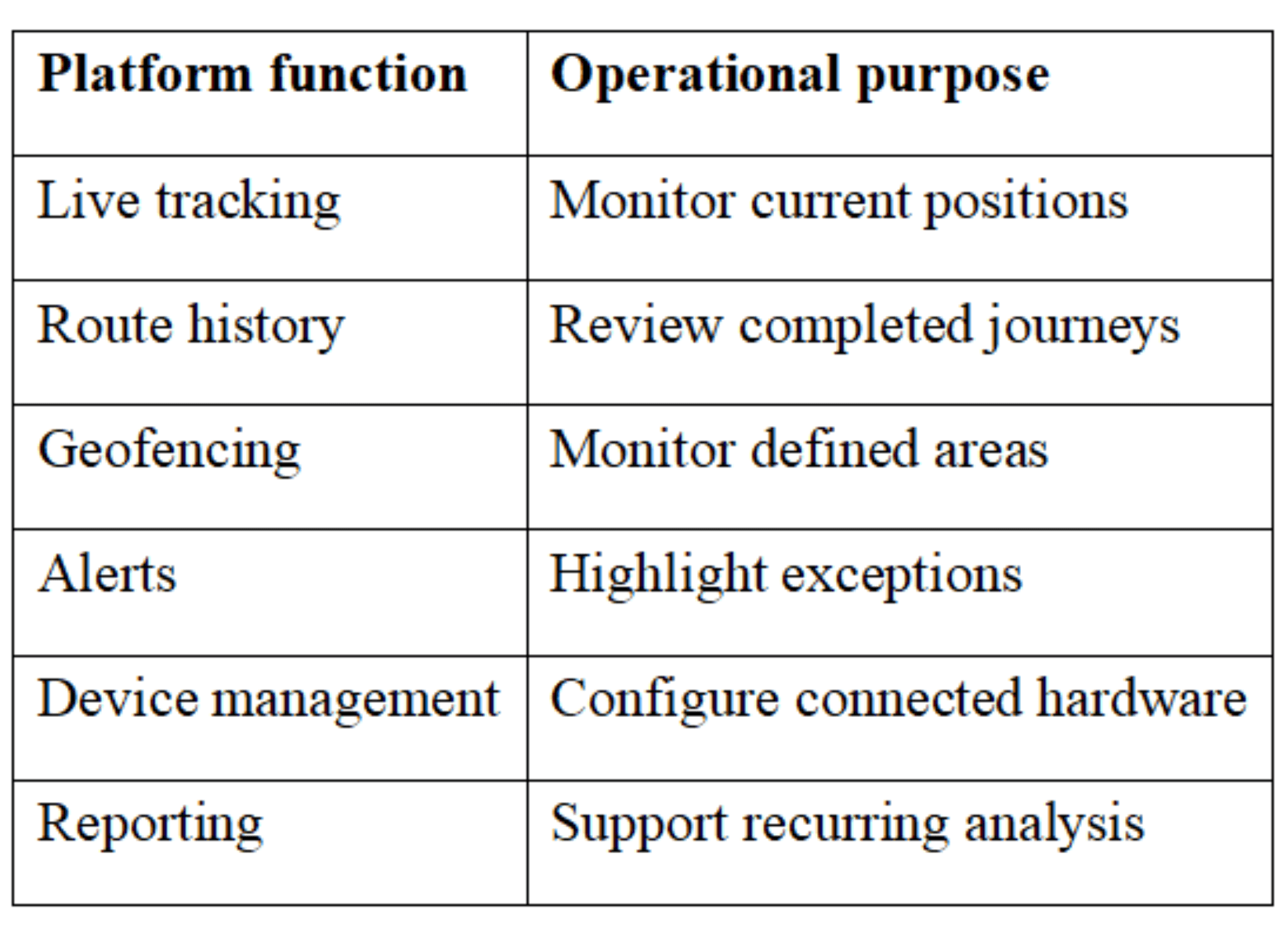
Our platform environment includes BSJ Configurator for device setup and parameter configuration, BSJ FOTA Web for remote firmware updates and maintenance, and the BSJ Monitoring System for live video monitoring, GPS tracking, event playback, and fleet status visibility.
The value of software is its ability to connect events into workflows, turning raw information into alerts, evidence, and operational insights.
GPS data becomes more informative when combined with video and AI. Cameras can add visual context, while AI can identify selected safety events without requiring managers to review every recorded minute.
Our commercial portfolio combines GPS trackers with AI dashcams and MDVR systems. Depending on configuration, these systems can support ADAS, DMS, BSD, driver behavior analysis, video recording, remote access, and multi-channel monitoring.
AI complements GPS rather than replacing it. Location indicates where an event occurred; video and AI can help explain what happened.
Fleet technology is not a one-time installation. Devices may require parameter changes, firmware updates, troubleshooting, or other maintenance as needs evolve.
Remote management can reduce physical intervention for distributed fleets. Our FOTA and configuration tools support remote maintenance and larger deployments.
Post-installation management deserves the same attention as hardware.
Many operators already use transportation management platforms or third-party telematics services, so a connected telematics fleet management system should fit the existing technology environment where practical.
We support fleet-platform integration and OEM/ODM cooperation. Our solutions cover logistics, small vans, public transportation, mining, oil and gas, and cold-chain transportation. This flexibility also helps fleets add video, driver monitoring, temperature sensing, or other functions later.
A system that works well for a small deployment should also have a path toward larger fleets. Device management, software architecture, hardware variety, and integration support all influence that scalability.
The development of connected fleet technology will also be showcased at IAA Transportation 2026. The event is scheduled for September 15–20, 2026, in Hannover, Germany, where we will exhibit in Hall 12, Stand B74. We will present AI video telematics, GPS tracking, AI MDVR systems, and connected fleet technologies for commercial mobility and transportation applications.

For fleet operators, integrators, and mobility technology providers, the event provides an opportunity to discuss system architecture, integration, and deployment requirements.
Bringing the Components Together
A complete tracking architecture can be summarized as:
Positioning → Connectivity → Vehicle Data → Platform → Video/AI → Alerts and Action
Each layer solves a different problem. Positioning establishes location. Connectivity moves information. Vehicle inputs add context. Software organizes the data. Video and AI enrich event understanding. Management workflows turn information into action.
At BSJ Technology, we approach fleet telematics as a connected ecosystem rather than a single GPS device. Our hardware and software portfolio is designed to support vehicle monitoring, safety, video management, and connected fleet operations across different commercial applications.

BSJ Technology (SZSE: 301608) is a global provider of AI Video Telematics and Connected Fleet IoT solutions. Since 2009, BSJ has developed AI Dashcams, MDVR systems, and GPS tracking solutions for commercial fleets worldwide.