Choose your operating system to start
A single camera can provide useful evidence, but large commercial vehicles often need visibility from several directions. Buses, trucks, construction vehicles, and other fleet vehicles can have front, rear, side, and cabin areas that cannot be covered effectively from one viewpoint. A multi-camera recording architecture addresses this challenge by bringing several video sources into one onboard unit.
We develop AI-powered Mobile Digital Video Recorder technology for commercial fleets, combining multi-channel video collection with real-time uploads, playback, and intelligent safety functions. Our AI MDVR portfolio is designed for applications where operators need more than isolated camera footage and require a centralized way to collect and manage video from multiple vehicle cameras.
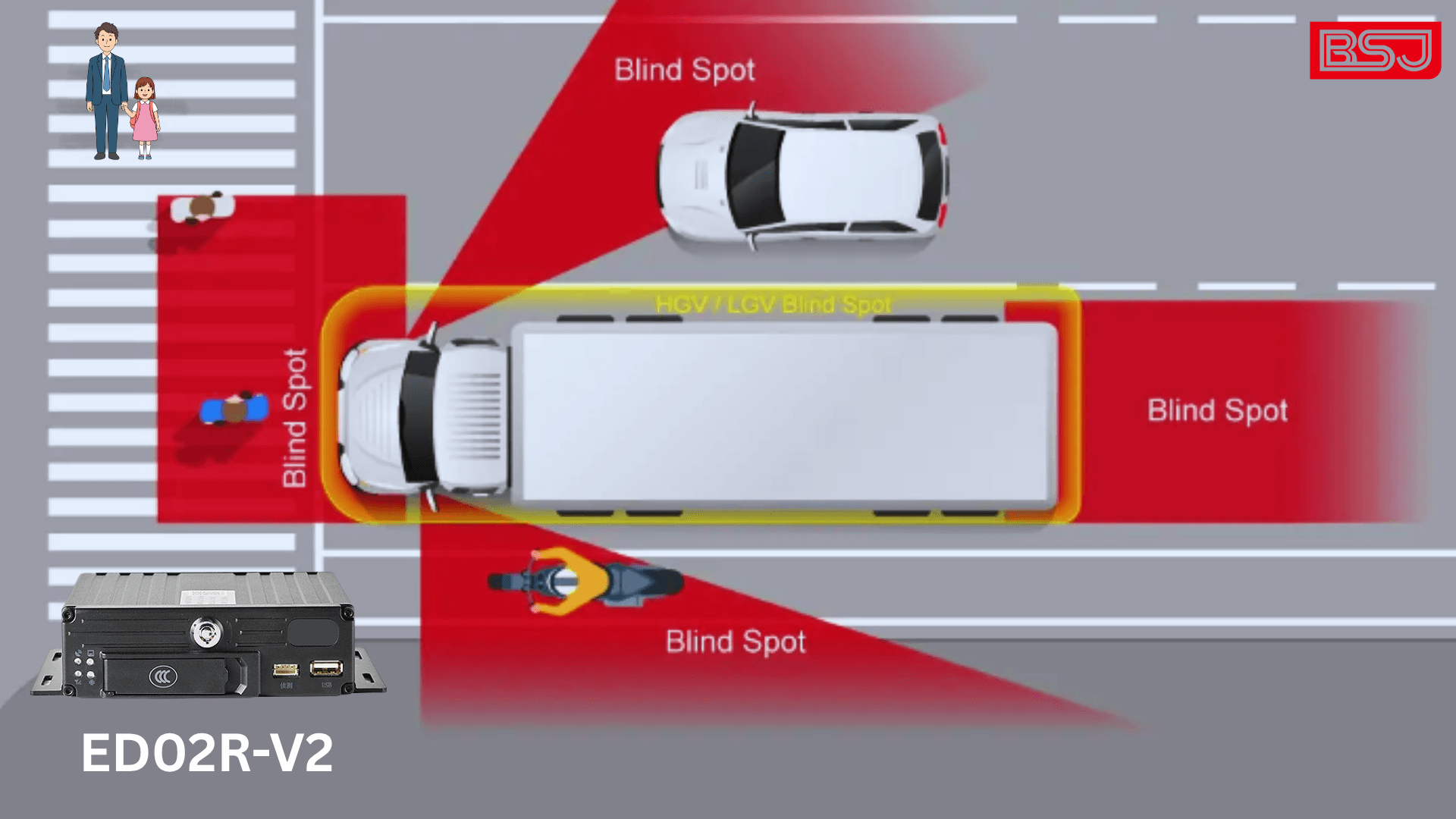
The first consideration is vehicle geometry. A long truck, city bus, or construction machine can have substantial areas outside the driver's direct field of view. Front-facing recording alone may capture the road while leaving blind spots, passenger areas, cargo sections, or rear approaches undocumented.
A properly selected mdvr camera arrangement can divide monitoring responsibilities across several views. The exact number and position depend on the vehicle, operating environment, and safety objectives.
For example, our ED02R-V2 supports four channels of 1080P or 720P video collection, while the ED08R-V2 supports eight channels. Both are designed to provide multi-camera coverage together with real-time video upload and playback.
A multi-camera fleet needs an onboard unit capable of receiving and organizing video from several sources. This is the core role of an MDVR and its integrated mdvr camera system.
Rather than installing separate recorders for individual cameras, a centralized recorder can collect multiple channels and maintain them within the same vehicle system. The approach simplifies video management and makes it easier to associate different camera views with the same vehicle and operating period.
Our ED08R-V2 is an eight-channel AI-powered MDVR designed for large fleets, including logistics, construction, and public transportation. It supports 1080P or 720P video collection, real-time uploads, playback, and access to historical video.
This kind of architecture is particularly useful when a fleet needs several camera angles but wants one central recording and management point.
Local recording and remote access are complementary rather than interchangeable. Continuous or event-based recording creates a historical record, while remote transmission allows fleet personnel to access selected information without being physically beside the vehicle.
Our AI MDVR devices support real-time uploads and video playback. This provides fleet teams with a way to review historical footage and, where configured, access relevant information remotely.
A mobile dvr system can therefore support two different workflows. Routine recordings provide an archive for later investigation, while transmitted video and event information can support active fleet monitoring.
The distinction becomes important during incidents. Managers may need to review footage after a collision, while safety teams may need immediate information when an abnormal event occurs.
Video recording preserves evidence, but AI can help identify specific risks within that video environment.
Our AI MDVR devices support Advanced Driver Assistance Systems, Driver Monitoring Systems, and Blind Spot Detection. The ED02R-V2 and ED08R-V2 combine these functions with multi-channel recording, allowing fleets to connect safety detection with camera coverage.
BSD is particularly relevant to vehicles with significant blind spots. The ED08R-V2 uses multi-angle AI vision to detect nearby vehicles, cyclists, and pedestrians in blind-spot areas. This means the camera system can contribute not only to post-incident investigation, but also to proactive warnings during vehicle operation.
Adding more cameras does not automatically create better monitoring. The useful question is what each camera is expected to observe.
A typical planning process can consider:
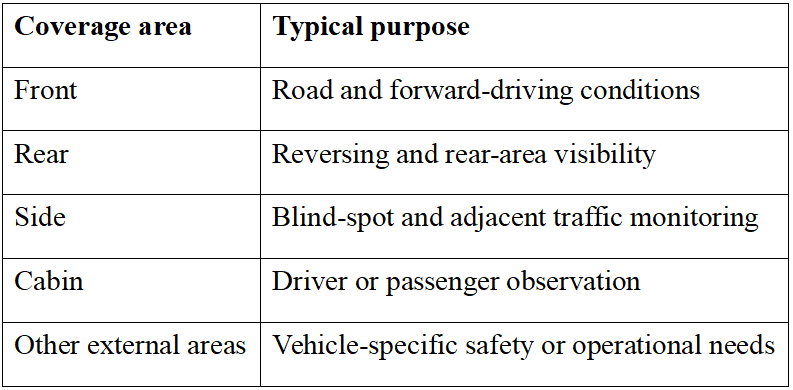
The appropriate arrangement depends on the vehicle and application. A public bus may prioritize passenger and driver monitoring, while a construction vehicle may place greater emphasis on blind spots around equipment.
Large fleets introduce another challenge: maintaining devices after installation. An operator may have hundreds of vehicles in different locations, making physical access inefficient for routine software maintenance. A reliable mobile dvr system reduces frequent on-site servicing requirements through intelligent remote management capabilities.
Our AI MDVR ecosystem supports BSJ Configurator and FOTA Web for parameter setup and remote firmware updates. This helps operators manage connected equipment with fewer manual interventions. The ED02R-V2 and ED08R-V2 are both presented as part of this unified device ecosystem.
Centralized management can also simplify deployment when a fleet uses trackers, dashcams, and MDVRs from the same technology ecosystem.
Video should not exist as a completely separate information source. Its value increases when it can be connected with other fleet information.
Our MDVR solutions support real-time video management and are designed to work with the broader BSJ monitoring and fleet-management environment. The company's commercial fleet portfolio also includes AI dashcams, GPS trackers, cameras, and other connected vehicle devices.
For operators, this creates a more consistent approach to monitoring vehicles, reviewing events, and managing onboard hardware.
What to Evaluate Before Deployment
Before selecting a multi-camera video system, fleet managers should examine several practical factors:
These factors help ensure that the chosen recorder is matched to the actual operating environment rather than selected solely by channel count.
At BSJ , we develop AI MDVR systems that combine multi-channel video recording, real-time transmission, playback, and AI safety capabilities for commercial fleets. Our portfolio includes four-channel and eight-channel solutions, giving operators different options for vehicle-specific camera requirements.
A vehicle video monitoring system becomes more useful when cameras, recording hardware, AI functions, connectivity, and remote management are designed as one architecture. For multi-camera fleets, the goal is not simply to install additional cameras. It is to create a reliable way to collect different views, identify relevant safety events, preserve video evidence, and make that information accessible to the people responsible for fleet operations.

BSJ Technology (SZSE: 301608) is a global provider of AI Video Telematics and Connected Fleet IoT solutions. Since 2009, BSJ has developed AI Dashcams, MDVR systems, and GPS tracking solutions for commercial fleets worldwide.