Choose your operating system to start
Building a resilient commercial telematics network requires a thorough evaluation of the underlying hardware powering daily operations. In enterprise logistics, public transit, cold-chain distribution, and heavy machinery fleets, location data serves as the foundational layer for dispatching, safety, and asset management functions. However, fleet directors and system integrators frequently face challenges when selecting hardware.

Choosing low-cost consumer devices often leads to signal loss, corrupted telemetry, high failure rates in extreme weather, and severe maintenance overhead. At BSJ, we recognize that enterprise telematics hardware must deliver consistent performance across demanding industrial environments.
Selecting terminal hardware requires looking beyond basic location mapping to evaluate critical engineering specifications, including positioning engine multi-constellation support, global cellular modem compatibility, power surge protection, and open interface scalability. This technical guide breaks down the essential hardware requirements necessary to construct a reliable, future-proof vehicle monitoring framework.
The primary function of any commercial telematics terminal is establishing precise, continuous position coordinates. In urban canyons surrounded by high-rise buildings, deep valleys, or dense forest corridors, basic single-band GPS receivers often experience multi-path interference and signal drift.
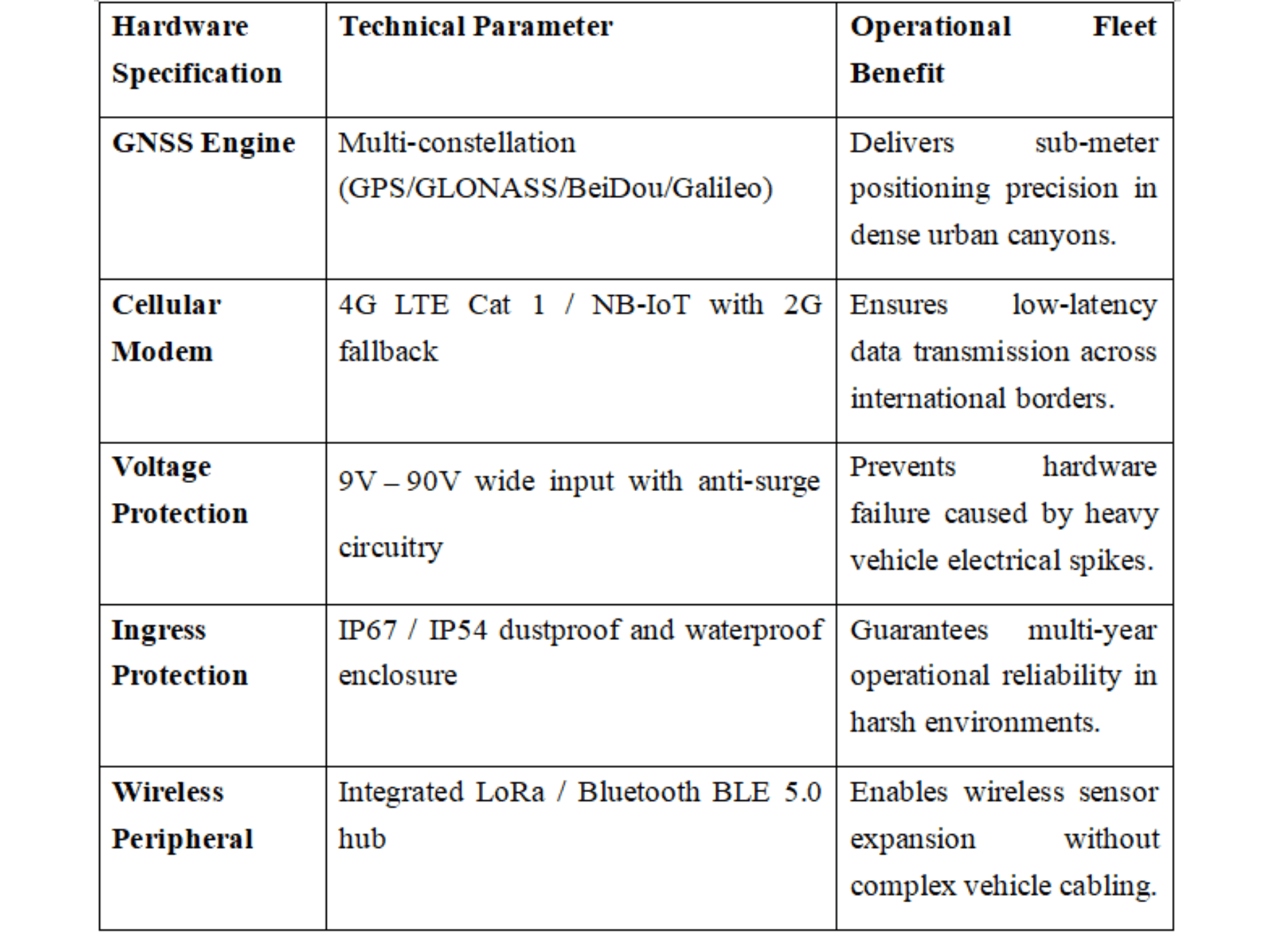
To guarantee sub-meter accuracy and rapid positioning, enterprise hardware must integrate multi-constellation GNSS engines capable of concurrently receiving signals from GPS, GLONASS, BeiDou, and Galileo constellations. Combining multiple satellite signals drastically reduces positional error and ensures continuous tracking along complex transit routes.
Furthermore, location data must be transmitted to central servers reliably. Deploying an advanced vehicle tracking GPS terminal requires cellular module versatility. Hardware should incorporate global 4G LTE Cat 1 or NB-IoT connectivity with automated 2G fallback options, ensuring seamless carrier handovers across regional borders. In addition to cellular transmission, onboard data buffering is a vital requirement.
When a commercial truck travels through remote dead zones lacking network coverage, the device must store thousands of timestamped location points in local flash memory. Once cellular connectivity resumes, the terminal automatically synchronizes buffered data logs with the cloud platform, preventing gaps in trip reporting. Utilizing robust vehicle tracking GPS hardware ensures fleet managers maintain complete auditability without missing critical route milestones.
Commercial transport vehicles expose electronic hardware to harsh operational conditions, including severe vibration, moisture, ambient heat, and unstable electrical supplies. Heavy-duty vehicles generate significant voltage spikes during engine ignition or alternator switches.
Consequently, an enterprise-grade GPS tracker device must incorporate a wide operating voltage input range—typically from 9V up to 90V DC—alongside integrated over-voltage, over-current, and reverse-polarity protections. These protective mechanisms prevent terminal burnout and ensure uninterrupted operation across heavy machinery.
In addition to electrical stability, physical housing parameters and peripheral sensor interfaces dictate long-term durability. Enclosures should feature flame-retardant materials and carry industrial ingress protection ratings to resist dust, high-pressure water jets, and corrosive chemicals. Furthermore, an industrial GPS tracker device must support versatile I/O interfaces, such as CAN bus protocols (J1939/OBD-II), RS232/RS485 serial ports, digital inputs for door magnetic sensors, and output relays for remote fuel or power cut-off.
To assist system integrators during procurement, the table below outlines core technical parameters and their corresponding operational benefits:
When deploying location tracking hardware across diverse fleets, hardware requirements naturally shift based on powering methods and installation environments. Enterprise buyers generally select between hardwired vehicle units and self-powered portable hardware depending on the operational scope:
Selecting the right hardware foundation is the single most critical factor in guaranteeing long-term telematics project success. By prioritizing multi-constellation GNSS precision, wide voltage protection, rugged enclosures, and flexible sensor connectivity, enterprise buyers establish a highly reliable tracking network. Partnering with an experienced manufacturer ensures access to robust engineering reserves and continuous technical support.
At BSJ Technology, we support global fleet deployments through our dedicated team of over 400 R&D personnel and a professional global technical support department. Our flexible OEM/ODM manufacturing models deliver faster customization capabilities and strictly controllable delivery lead times, allowing clients to deploy tailored solutions efficiently.
Whether you require customized firmware, specialized peripheral wiring, or proprietary sensor protocols, our high-performance terminals provide competitive pricing without compromising quality. Equipping your commercial fleet with robust tracking terminals safeguards operational assets, optimizes logistics efficiency, and provides the actionable data necessary to maintain a strong competitive edge in transport management.

BSJ Technology (SZSE: 301608) is a global provider of AI Video Telematics and Connected Fleet IoT solutions. Since 2009, BSJ has developed AI Dashcams, MDVR systems, and GPS tracking solutions for commercial fleets worldwide.