Choose your operating system to start
Last-mile fleets compress dozens of operational decisions into a single shift. Vans leave depots, enter dense traffic, stop repeatedly, serve changing delivery windows, and may carry goods that require security or proof of service. Across dense delivery networks, van fleet management is most useful when it turns frequent vehicle data into clear exceptions for dispatch, safety, customer service, and maintenance instead of asking staff to watch every route continuously.
The hardware economics are also different from heavy-vehicle projects. Vehicle counts can be high, installation time must remain short, cabin space is limited, and margins per stop may be tight. A fleet buyer should therefore balance update frequency, video coverage, network consumption, device power, remote maintenance, and software integration. The correct solution is the one that can be installed and supported repeatedly across a mixed van fleet without creating unnecessary field work.
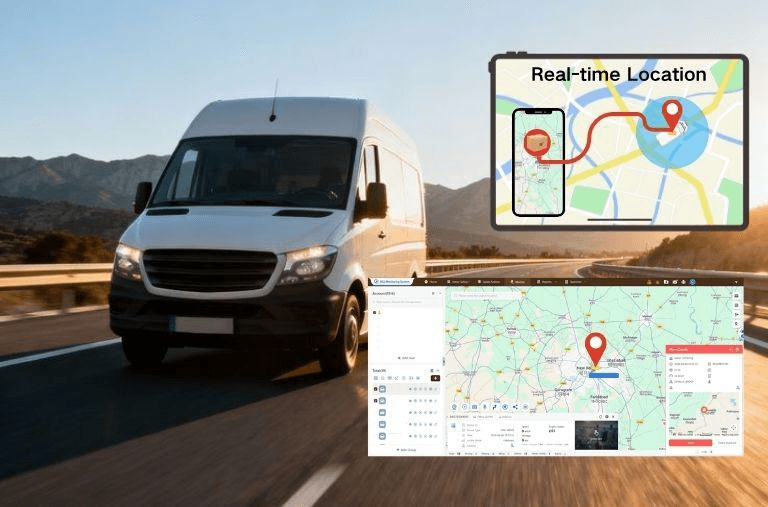
Position updates should answer practical dispatch questions: which vans have left the depot, where delays are forming, whether a vehicle missed an expected area, and how long it remained at a stop. A van fleet management system can combine live position with route history and geofences so dispatchers see exceptions first rather than scanning a map for every vehicle. Reporting frequency should match service requirements.
Very frequent updates can improve visibility for time-critical operations, but they also increase communications and platform load. A pilot can compare several reporting intervals against the decisions dispatch actually makes. The fleet may find that high-frequency data is valuable during active delivery hours while slower reporting is sufficient for parked or low-risk vehicles. Geofence records can provide automatic evidence of depot departure, customer-area arrival, restricted-zone entry, or unexpected detours.
Those events become more useful when they share identifiers with delivery jobs or customer records. The telematics system does not need to replace order-management software; stable interfaces can allow route and location events to enrich the business system the dispatcher already uses. Power management matters because vans may be parked for long periods between shifts.
Tracking, cameras, and communications need controlled ignition-off behavior so monitoring requirements do not create avoidable battery problems. Buyers should test sleep, wake-up, low-voltage protection, and the time required for the device to restore connectivity when the next shift begins.
Video should be planned around defined evidence needs. A road-facing view can support collision review, a driver-facing camera can provide context for DMS events, and a cargo or external view may help with theft or delivery disputes. Small cabins require careful mounting so equipment does not obstruct the driver or become difficult to service. Camera angles should be standardized during pilot installation.
In our small-vehicle projects at BSJ Technology, we combine 4G GPS tracking with compact AI dashcams, driver-safety functions, video evidence, and vehicle information. We also support open software integration and OEM/ODM options. This is relevant to delivery operators, distributors, and telematics providers that want a repeatable hardware package while keeping their own platform or customer-facing application. AI alerts should be configured to reduce rather than add workload.
Drowsiness, distraction, seatbelt, following-distance, or lane-related events can be useful where supported, but the fleet needs severity rules and a review process. The same event may be treated differently at depot speed and on a motorway. Location, speed, and video context help safety teams decide whether an alert requires coaching or no further action. Cargo evidence should follow a retention policy.
Not every delivery needs continuous video uploaded to the cloud, and storing all footage centrally can be costly. Event clips, customer disputes, or suspected access incidents may justify rapid retrieval, while routine recording can remain local for a defined period. Clear permissions protect both operational usefulness and privacy.
Installation repeatability is a major cost driver. Pilot vehicles should represent different van ages, electrical layouts, windshield shapes, network conditions, and intended camera configurations. Teams can measure fitting time, cable routing, GPS performance, video quality, event upload, and device-health reporting. Lessons from that group should become a standard kit and checklist before high-volume deployment starts. Remote lifecycle management reduces later workshop work.
Firmware versions, parameters, connectivity, and diagnostic status can be managed centrally so a fleet does not depend on every van returning to one depot. Lifecycle planning in van fleet management should also define replacement and re-provisioning procedures, because a failed device or vehicle change needs to preserve the correct association between hardware, driver, and business record.
We use hardware engineering, controlled quality processes, global technical support, and third-party platform compatibility to support commercial fleet rollouts with different regional needs. Customization can include hardware or firmware development where the business case justifies it. Change control remains important: every special version should be documented so support teams know which configuration is installed in each customer or fleet group.
Last-mile visibility is valuable when it shortens the time between an exception and a practical dispatch decision. In our small-vehicle work at BSJ Technology, we combine compact tracking and video hardware with remote management and open integration so fleets can fit connected functions into dense delivery operations without adding unnecessary field work. Van fleet management should keep route progress, stop behavior, driver events, and device health easy to interpret across many vehicles.
A scalable van fleet management system also needs installation standards that can be repeated on different van models and software connections that preserve the operator's existing customer workflow. Once those elements are proven together, expansion can proceed by depot or vehicle group with fewer surprises in support, configuration, and operating cost.

BSJ Technology (SZSE: 301608) is a global provider of AI Video Telematics and Connected Fleet IoT solutions. Since 2009, BSJ has developed AI Dashcams, MDVR systems, and GPS tracking solutions for commercial fleets worldwide.