Choose your operating system to start
A truck fleet management project succeeds when onboard devices and software are designed around the same operating decisions. For truck fleets, logistics and fleet management may involve route visibility, driver safety, vehicle condition, cargo evidence, maintenance, and remote support, so a buyer needs more than a tracker or camera selected in isolation. The architecture should show how each data source contributes to dispatch, safety review, maintenance, or customer service.
Commercial truck buyers should ask how hardware will behave across different vehicle types, depots, regions, and software environments. A scalable design should account for positioning, AI video, multi-channel recording, sensor inputs, mobile connectivity, platform behavior, and remote settings control. Those requirements become especially important when a pilot must later be repeated across hundreds of vehicles without creating inconsistent installation or reporting rules.
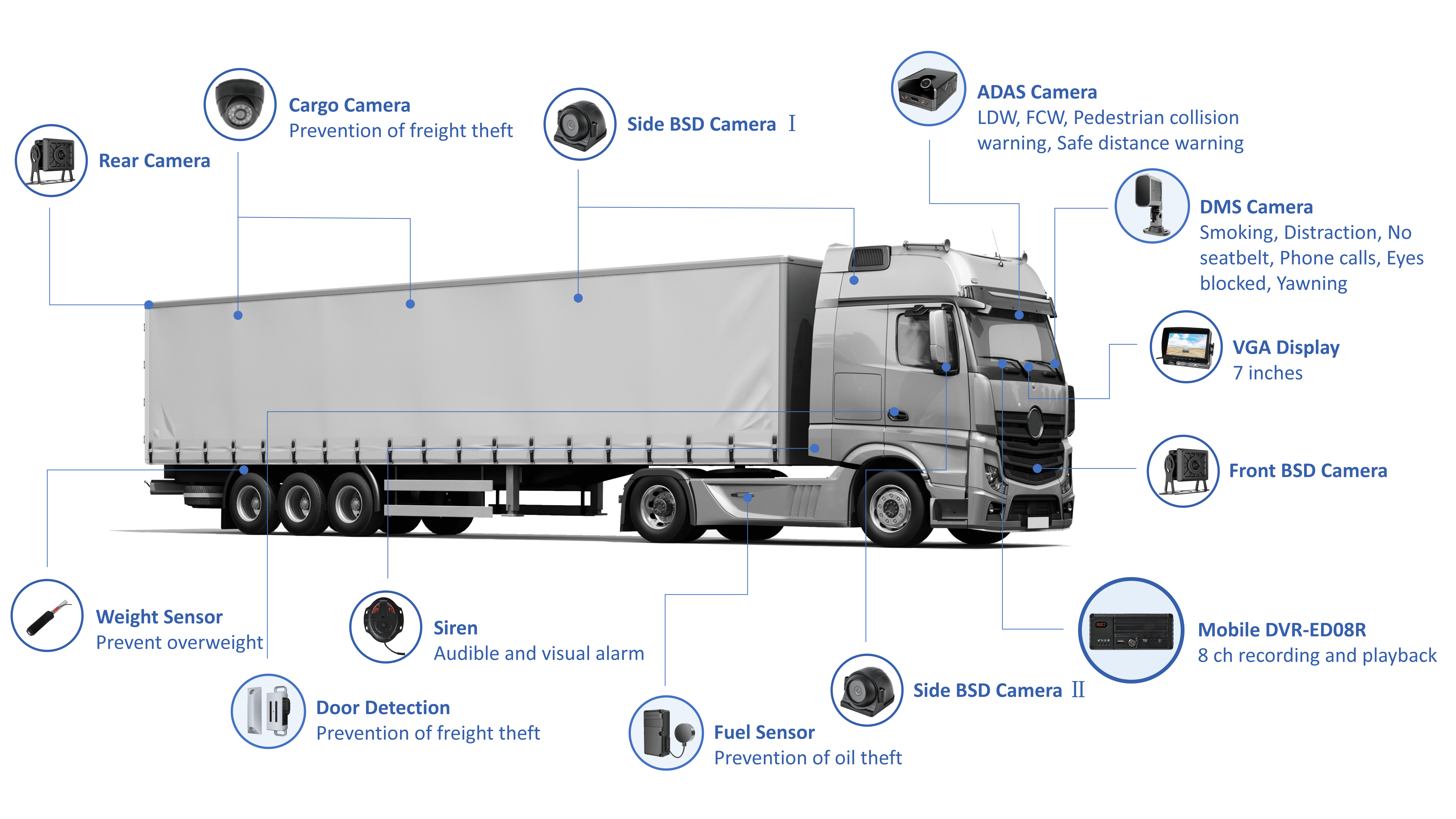
The hardware layer begins with the risks that need to be observed. GPS trackers can support position, route history, and geofence events, while AI dashcams can add ADAS and DMS alerts around road and driver behavior. Multi-channel MDVR equipment can provide additional viewpoints for cargo, sides, rear areas, or other zones that a single forward camera cannot document. Vehicle-health information can complement those visibility tools.
Our logistics solution can use engine condition, tire pressure, fuel consumption, and maintenance reminders among the data categories that may be monitored. Procurement teams should decide which signals are actually available on the target vehicles and which are necessary for the business process rather than assuming every truck requires the same sensor package. Installation quality deserves its own acceptance criteria.
Heavy trucks can differ in voltage, cabin layout, antenna placement, wiring access, vibration exposure, and accessory requirements. A logistics fleet management solutions deployment becomes easier to maintain when technicians use defined mounting points, cable routes, power protection, device naming, and commissioning checks for each vehicle class instead of adapting the design from scratch at every depot. Video requirements should also be tied to a clear evidence workflow.
High-definition footage can support collisions, cargo incidents, theft, vandalism, or insurance review, but storage and bandwidth have to match retention policy. Buyers should state which events require immediate upload, which footage remains local, who may retrieve it, and how the recording is linked to vehicle identity and time.
A platform must convert device data into operational actions. Location, video access, playback, alarms, and historical records need consistent identifiers so staff can move from a route exception to the correct vehicle and supporting evidence. For truck operations, we use configuration and FOTA tools that can reduce workshop visits when settings or firmware need management across distributed fleets. Integration becomes a commercial requirement when the customer already uses transport, dispatch, or fleet software.
For integration work, our team at BSJ Technology supports open-protocol connections with third-party platforms, allowing a hardware layer to feed an established software environment rather than forcing every buyer onto one interface. For an integrator, the important test is whether messages, alarms, timestamps, commands, and device status are interpreted consistently by the target platform. User roles and governance should be designed before scale.
A control room may need live position and alerts, safety staff may need video, maintenance teams may need device or vehicle status, and management may need aggregated reports. Each role should receive only the access required for its work, with clear retention and export rules for sensitive footage or customer data. Reliable logistics and fleet management also depends on fault visibility.
When a camera stops recording, a tracker loses communication, or a unit runs an outdated configuration, the fault should be identifiable before it matters during an incident. Remote diagnostics can help, but the supplier and fleet still need an escalation path covering hardware replacement, firmware issues, network faults, and integration troubleshooting.
Representative truck pilots should include different models, routes, network conditions, and driver shifts. Truck-pilot measurements can cover installation time, GPS continuity, alert usefulness, video retrieval, data consumption, device-health reporting, remote configuration, and integration behavior. These measurements turn a technology trial into an operational acceptance test and reveal where deployment standards need adjustment before volume ordering. Our project work also treats customization as a controlled engineering process.
OEM/ODM requirements may involve hardware interfaces, branded firmware, accessories, or third-party platform behavior, but changes should be documented and tested against the same acceptance criteria as the standard configuration. That discipline reduces the risk that a customized batch becomes difficult to support after rollout. Long-term fleet consistency requires version control. Device models, firmware, camera layouts, alert thresholds, SIM profiles, and reporting definitions should be traceable by vehicle group.
When several depots use the same logistics fleet management solutions, common baselines make troubleshooting and performance review more reliable because teams are comparing equivalent configurations rather than hidden local variations. Truck technology becomes scalable when hardware and platform decisions are made against the same operating model.
In our truck-fleet projects at BSJ Technology, we connect logistics and fleet management requirements with GPS, AI video, MDVR, configuration tools, and integration support while keeping installation and firmware baselines controlled by vehicle class. Logistics fleet management solutions should make the same event understandable to dispatch, safety, and maintenance without requiring each department to reconstruct the data independently.
We use representative truck pilots to expose power, network, camera, and software differences before volume ordering. The resulting standards make later depot expansion more predictable because new vehicles enter an established technical framework instead of creating another local configuration that support teams have to rediscover.

BSJ Technology (SZSE: 301608) is a global provider of AI Video Telematics and Connected Fleet IoT solutions. Since 2009, BSJ has developed AI Dashcams, MDVR systems, and GPS tracking solutions for commercial fleets worldwide.