Choose your operating system to start
Public bus operations depend on more than keeping vehicles on scheduled routes. Operators also need accurate information about vehicle positions, driver behavior, passenger conditions, and service performance. A connected bus solution brings these areas together through GPS devices, sensors, cameras, communications, and cloud-based analytics.
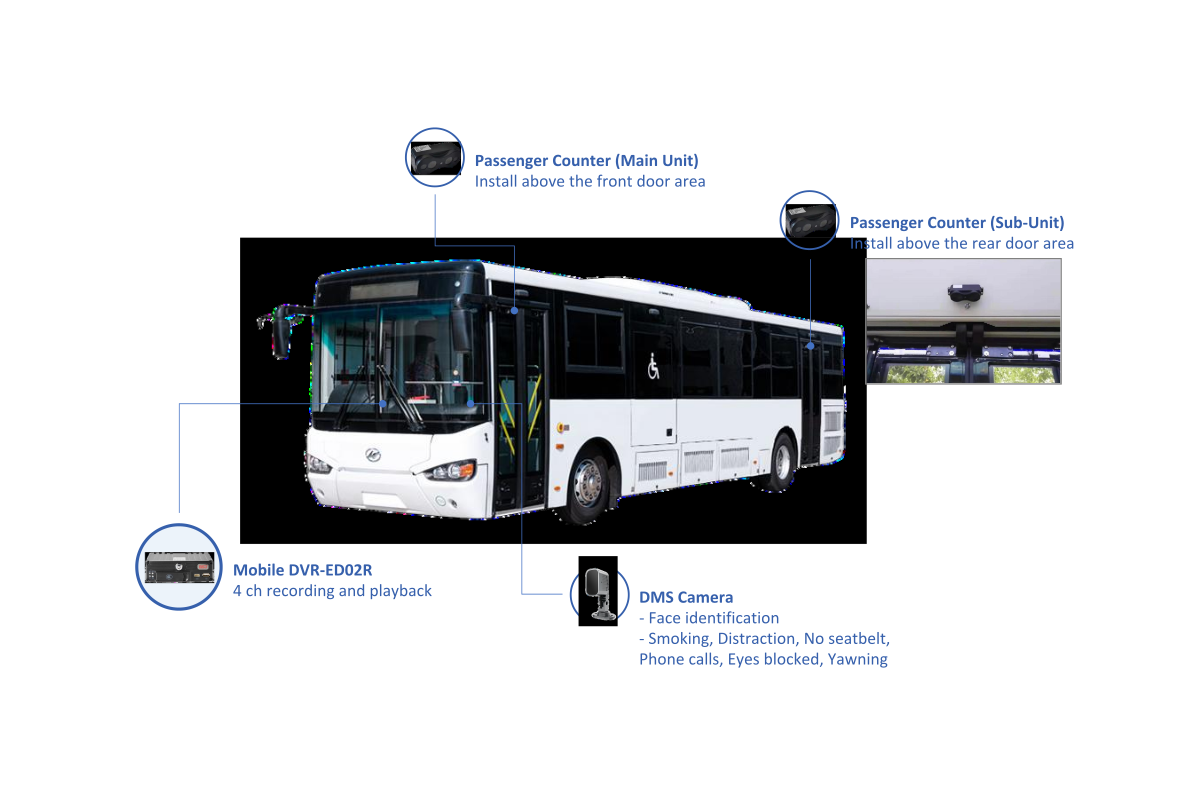
We develop IoT technology and advanced hardware solutions for public buses with a focus on real-time monitoring, system integration, durable hardware, data security, and user-friendly fleet management. This combination is intended to give transit operators a clearer view of daily operations while supporting safer and more efficient services.
For a bus network, knowing the planned timetable is not enough. Operators need to understand how vehicles are actually moving during service.
Our public bus solution uses GPS devices and sensors to provide real-time vehicle tracking and operational monitoring. Accurate location information can support route planning and fleet scheduling while helping operators identify delays and operational inefficiencies.
For operators evaluating public transit solutions, the value of GPS is therefore closely related to how location information can support daily scheduling decisions. Instead of relying only on planned routes, fleet personnel can use current vehicle positions as part of operational monitoring.
A bus can be correctly positioned and still present a safety concern. Driver condition and driving behavior remain important parts of public transportation management.
Our solution incorporates Driver Monitoring Systems (DMS) and Advanced Driver Assistance Systems (ADAS). These technologies are designed to detect driver behaviors such as fatigue and distraction. The system can also provide alerts related to overspeeding, route deviations, and unauthorized stops, enabling timely action when necessary.
This gives fleet personnel more information for safety-related management. Instead of considering vehicle location alone, operators can also monitor specific driver behaviors that may affect passenger and road safety.
The cabin is another area that requires visibility. GPS can describe where the vehicle is, but it cannot show what is happening inside the bus.
Our public bus solution uses HD cameras to monitor passenger behavior and detect overcrowding. The cameras can also support quick responses to onboard incidents and contribute to a safer and more comfortable passenger experience.
For a public transportation system, this visual information adds an important operational dimension. When an onboard incident occurs, recorded camera information can provide useful context that cannot be obtained from GPS data alone.
Connected buses can generate substantial amounts of vehicle, driver, and passenger data. Without an analytical environment, that information can be difficult to evaluate consistently across the fleet.
Our public bus solution uses cloud-based platforms to analyze vehicle performance, driver behaviors, and passenger data. These analytics capabilities are intended to provide actionable insights for improving fleet efficiency, reducing downtime, and supporting data-driven operational decisions.
This creates a distinction between monitoring and management. Real-time tracking helps operators understand current fleet conditions, while cloud-based analysis provides information that can support broader decisions about ongoing operations.
A bus fleet may involve multiple technologies for tracking, surveillance, driver monitoring, and operational management. Running each function separately can make information harder to coordinate.
System integration is therefore one of the core elements of our public bus offering. We combine real-time vehicle monitoring, driver safety technologies, cabin monitoring, and data analytics within an IoT-based solution.
This structure helps connect information from different operational areas. Location data can support scheduling, driver monitoring can support safety management, and cabin cameras can contribute to incident handling and passenger-related oversight.
Technology installed on public buses must be suitable for routine fleet operation. Hardware needs to be durable and adaptable, while the overall system must also address data security and ease of use.
Our public transit solutions specifically highlights durable and adaptable hardware, robust data security, and user-friendly systems. These characteristics are important for operators managing fleets where equipment needs to support regular service without making daily operations unnecessarily difficult.
The solution also emphasizes after-sales and technical support. For transit operators, this support complements the technology itself by providing assistance beyond the initial deployment.
When assessing a smart bus deployment, operators can examine the main functional areas together:
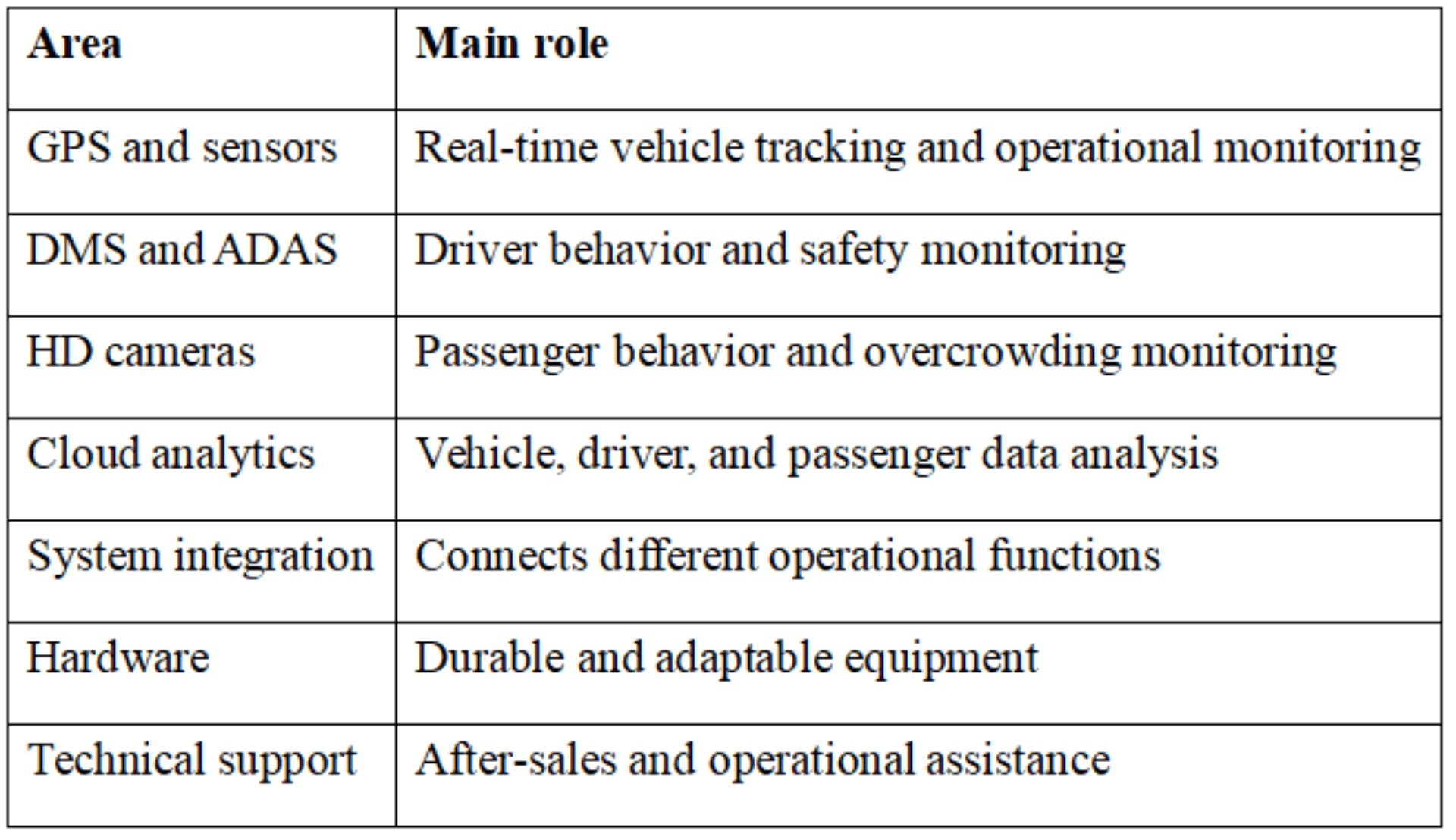
This approach reflects the capabilities specifically presented in our public bus solution rather than treating cameras, GPS, or software as isolated technologies.
Smart public transportation does not necessarily mean putting the maximum number of devices on every vehicle. A more practical approach is to collect information that addresses clearly defined safety and operational needs, then make that information useful to fleet personnel.
At BSJ/BSJ Technology, we combine IoT technology and advanced hardware solutions for public buses with real-time monitoring, intelligent scheduling support, driver behavior monitoring, cabin monitoring, and cloud-based data analytics. Our public bus offering is designed around the specific requirements of passenger safety, operational visibility, system integration, durable hardware, data security, and ongoing technical support.
A connected bus strategy becomes more effective when these functions complement one another. GPS supports visibility and scheduling, DMS and ADAS address driver behavior, HD cameras provide cabin information, and cloud analytics helps operators interpret vehicle, driver, and passenger data. Together, these capabilities provide a technology foundation for managing public bus operations with more informed, data-based decisions.

BSJ Technology (SZSE: 301608) is a global provider of AI Video Telematics and Connected Fleet IoT solutions. Since 2009, BSJ has developed AI Dashcams, MDVR systems, and GPS tracking solutions for commercial fleets worldwide.