Choose your operating system to start
Fleet operators, logistics managers, distributors, and system integrators face increasing operating costs, safety liabilities, and tracking complexities. Choosing the right fleet management solution requires more than basic GPS location tracking. Hardware reliability, AI video monitoring, driving behavior analysis, and platform connectivity should be considered to determine whether a solution can support daily operations and long-term fleet growth.

Commercial vehicle operators face persistent margin pressure caused by unmonitored assets, fuel discrepancies, unsafe driving, vehicle downtime, and fragmented software systems. Basic GPS tracking solutions can show where vehicles are, but they may not explain what happened inside or around them when an incident occurs.
Modern fleet telematics solutions combine satellite positioning, vehicle data, video monitoring, and AI analytics to provide a more complete view of fleet activity. This combination allows fleet managers to move beyond simply locating vehicles and gain greater visibility into driving events, vehicle conditions, and potential safety risks.
Unmonitored fuel tanks and visual blind spots can create financial and safety risks during overnight stops, loading activities, or long-distance transit. Basic tracking devices can show vehicle location but cannot provide visual context when suspicious activity occurs.
Combining GPS positioning with camera coverage and AI-based detection gives fleet managers better visibility around vulnerable areas. Video footage can help identify unusual activity near fuel tanks, cargo compartments, or blind spots, while GPS data provides the location and time context needed for incident investigation.
Driver fatigue, mobile phone use, harsh braking, and rapid acceleration can increase accident exposure, vehicle wear, and liability costs. Without in-cabin monitoring, fleet managers may have limited visibility into the behaviors behind these events.
AI video monitoring and driving behavior analysis can help identify risky patterns and provide context for specific incidents. At the same time, integrating GPS, video, and vehicle data through connected fleet platforms reduces data silos and makes it easier to manage information across different vehicles, regions, and business units.
Selecting scalable GPS tracking solutions requires more than comparing location accuracy or tracking frequency. Fleet operators should evaluate how well a solution combines GPS positioning, AI video monitoring, driver behavior analysis, and platform connectivity. These capabilities determine whether the system can provide useful operational context today while remaining adaptable as fleet requirements grow.
GPS tracking shows where a vehicle is, but video can help explain what is happening around and inside it. Combining multi-GNSS positioning with HD video allows fleet managers to connect vehicle location, speed, road conditions, and driver actions within the same event.
This combination is particularly useful for incident verification, cargo protection, and driver safety management. Instead of relying on location data alone, operators can review visual evidence alongside telematics information to understand an event and respond more effectively.
Driver behavior analysis helps fleet managers identify risks such as lane departures, forward collision risks, smoking, and driver fatigue. Edge-based ADAS and DMS can provide immediate alerts, while recorded event clips support incident review and driver coaching.
Open platform connectivity is another important selection factor. Protocols such as JT/T 808 and APIs allow telematics data to connect with existing fleet management software, helping operators avoid unnecessary system replacement and simplify future integration.
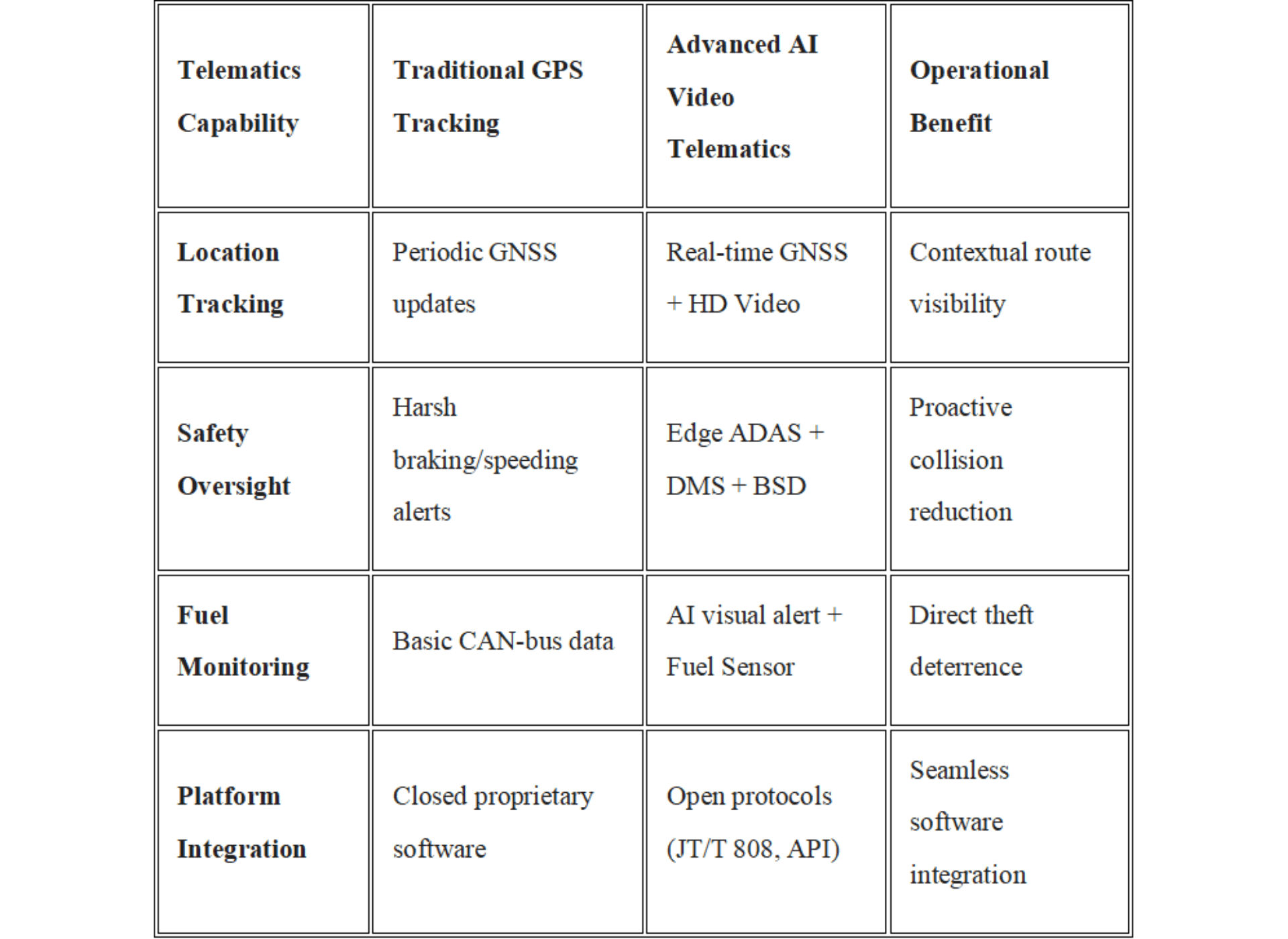
Open connectivity also makes it easier for distributors and system integrators to connect telematics devices with existing software environments such as Wialon, RedGPS, or Uffizio.
The capabilities above provide a practical framework for evaluating a fleet management solution. BSJ combines GPS tracking, AI video telematics, driver monitoring, and platform connectivity to support fleet operators, distributors, and system integrators across applications such as heavy trucks, buses, mining vehicles, and cold-chain assets.
BSJ offers different device types for fleets that require location tracking, video monitoring, or a combination of both. This allows operators to select hardware according to vehicle type, monitoring requirements, and existing telematics infrastructure.
Rugged 4G GPS Trackers: The C02G provides real-time tracking, ignition detection, and low-power sleep modes for commercial vehicles. For wire-free trailer deployment, the EG80G features a 7500mAh rechargeable battery, strong magnetic mount, and IP68 enclosure.
Multi-Channel fleet telematics solutions & AI MDVRs: Devices such as the ED02R-V2 and ED08R-V2 support multi-camera HD recording and integrate functions such as ADAS, DMS, and Blind Spot Detection (BSD). This enables fleets to combine location information with visual and driver-related event data.
BSJ Ecosystem Tools: Fleet deployment can be supported by BSJ Configurator, FOTA WEB for remote firmware updates, and the BSJ Monitor platform for real-time video streaming and asset management.
BSJ also supports open connectivity for integration with third-party telematics platforms and existing fleet software.
A 30-truck fleet in the UAE faced persistent oil theft from vehicle fuel tanks. After deploying BSJ ES803-V1 AI Cameras with 4G, GPS, HD video, and intelligent human detection, the fleet gained real-time alerts for suspicious activity around fuel tank areas. Within six months, the solution helped reduce oil theft incidents and achieved 35% cost savings for the client. The integrated design also simplified installation and supported remote device management through FOTA WEB. For more details, learn more about how the ES803 AI Camera helped prevent fuel theft in our case.

BSJ Technology (SZSE: 301608) is a global provider of AI Video Telematics and Connected Fleet IoT solutions. Since 2009, BSJ has developed AI Dashcams, MDVR systems, and GPS tracking solutions for commercial fleets worldwide.