Choose your operating system to start
Logistics operations depend on coordination. Orders need to be collected, transported, and delivered according to changing schedules, while trucks and drivers have to operate safely and efficiently throughout the process. We see logistics and fleet management as closely connected functions rather than independent activities. Logistics defines what needs to move and when, while fleet management provides the vehicle visibility and operational data needed to make those plans work in practice.
At BSJ Technology, we see vehicle telematics as the connection between both sides. By combining vehicle location, driver information, video, and operational data, businesses can gain a clearer understanding of transportation activity and use that information to improve day-to-day decision-making.
A truck fleet management strategy needs to support more than basic vehicle location. Knowing where a truck is can help dispatchers monitor deliveries, but they may also need to understand whether the vehicle is following its planned route, whether the driver is operating safely, and whether the vehicle is likely to complete the assigned journey on schedule.
We use GPS tracking as a fundamental part of our telematics approach. Real-time positioning can provide fleet managers with an overview of vehicle activity, while route monitoring and geofencing can help identify unexpected movements. When a truck leaves a predefined area or deviates from an expected route, an alert can give dispatch teams an opportunity to investigate the situation sooner.
This information creates a stronger link between logistics planning and transportation execution. Instead of waiting for a delivery problem to become obvious at the destination, managers can monitor progress during the journey and respond to potential issues while the vehicle is still in operation.
We believe logistics fleet management solutions should combine different data sources because GPS cannot explain every event that takes place during a delivery.
Driver behavior is one example. Speeding, harsh braking, and sudden acceleration can indicate driving conditions that deserve attention. Monitoring these events over time can help fleet managers understand patterns rather than focusing only on individual incidents. This information may also support driver coaching and safety programs.
Vehicle condition is another important consideration. Our logistics solutions can support monitoring of vehicle-related information, including engine status, fuel consumption, and tire pressure. When this data is considered alongside delivery schedules, businesses can better understand how vehicles are being used and where maintenance attention may be required.
This connection can be particularly useful for organizations operating large fleets. A vehicle that requires unexpected maintenance can affect more than one truck; it may also disrupt a delivery schedule, require reassignment of cargo, and increase pressure on other vehicles. Connecting fleet information with logistics planning helps operators see these consequences more clearly.
From our perspective, video is another important part of a connected fleet environment. A GPS system can show that a truck stopped suddenly, but video can provide additional context about what happened.
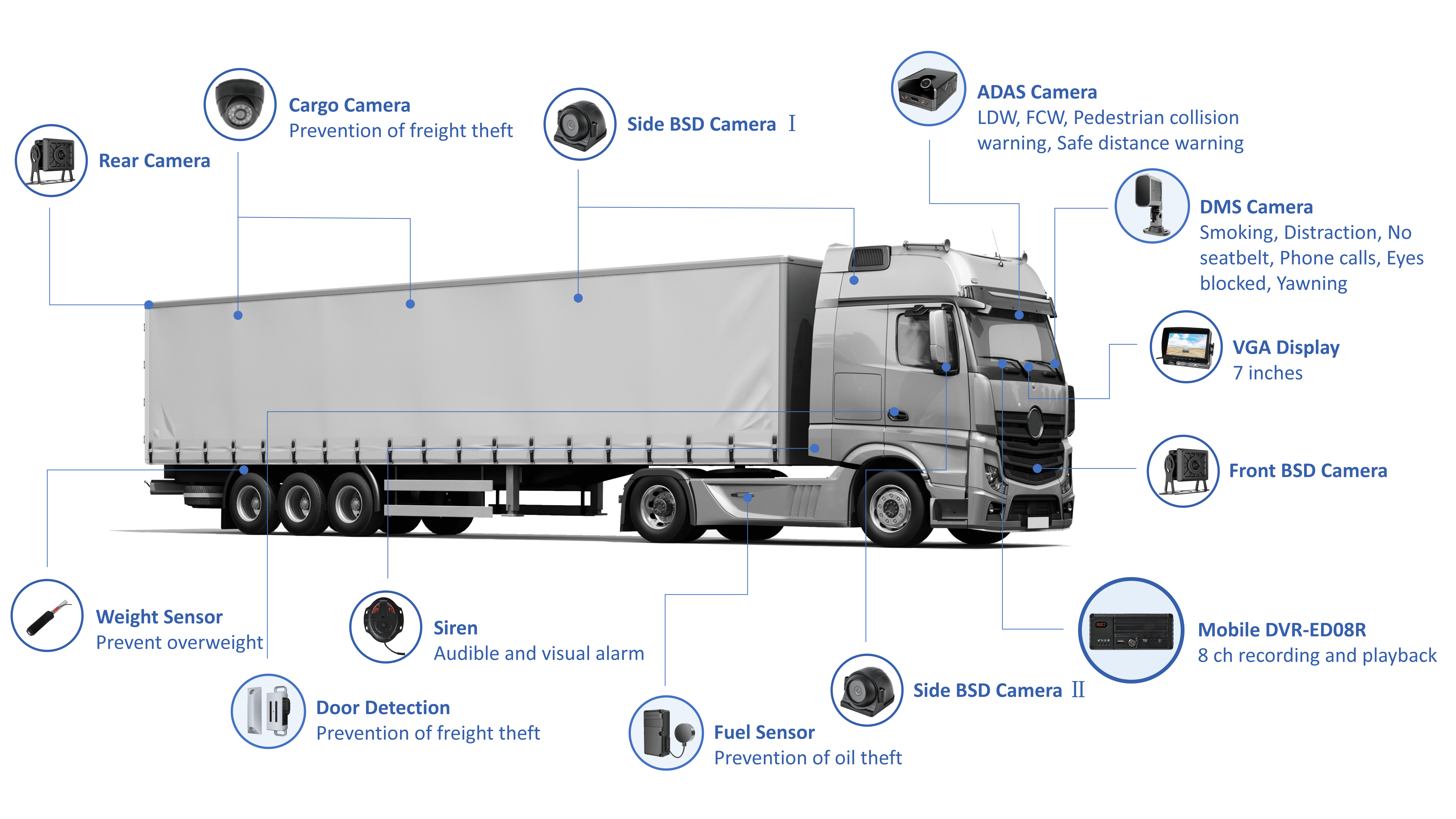
We provide AI dashcams and MDVR-based solutions that can support commercial fleet operations. Depending on the configuration, video systems can provide HD recording, live viewing, and intelligent safety functions such as Advanced Driver Assistance Systems and Driver Monitoring Systems.
For logistics companies, this information can be useful in several situations. Managers may need to investigate an accident, review a dangerous driving event, or understand circumstances surrounding a customer dispute. Video records can provide evidence that complements location and vehicle data.
The objective is not to collect video for its own sake. We see greater value in connecting video with telematics events so that managers can locate relevant footage more efficiently and use it as part of a broader operational review.
Once fleet information is centralized, companies can begin examining trends rather than individual journeys. Route histories, vehicle activity, driver behavior, and operational alerts can reveal patterns that are difficult to identify through manual supervision.
For example, repeated delays on one route may indicate that scheduled travel times do not reflect actual operating conditions. Frequent vehicle alerts may suggest that certain assets require closer maintenance attention. Repeated driving events may indicate an opportunity for additional driver training.
We believe this type of analysis is one of the most valuable connections between logistics and fleet management. Fleet data describes what happened on the road, while logistics data provides the business context needed to understand why that information matters.
As logistics businesses expand, technology must scale with them. Managing a small group of vehicles manually may be possible, but larger fleets require centralized monitoring, consistent hardware, and efficient device management.
We develop a range of telematics hardware for different commercial transportation requirements, including GPS trackers, AI dashcams, and MDVR systems. Our solutions are also designed with integration in mind. For businesses that already use third-party fleet platforms, compatibility can reduce the need to replace an established software environment.
This is particularly important for B2B customers and system integrators. Hardware deployment is only one part of a fleet technology project. Configuration, technical support, software integration, ongoing maintenance, and future expansion all need to be considered when selecting a telematics supplier.
We see truck fleet management as an operational layer that supports broader logistics objectives. Tracking vehicles, monitoring drivers, and collecting vehicle information become more useful when those capabilities are connected to delivery planning and business decisions.
At BSJ Technology, we focus on AI video telematics, Fleet IoT, GPS tracking, and fleet management technologies. We also support flexible OEM and ODM cooperation, faster customization, and integration with third-party software platforms to accommodate different project requirements.
Ultimately, the relationship between logistics and fleet management is about information flow. A logistics team needs to know whether transportation resources can meet delivery requirements, while fleet managers need to understand how vehicles are being used within the wider operation. When these perspectives are connected, businesses can respond to disruptions more effectively, identify recurring problems, and make better use of their transportation resources.
For this reason, we believe logistics fleet management solutions should be evaluated as part of the entire logistics workflow, not simply as vehicle tracking tools. A connected telematics environment can provide the visibility needed to link vehicle operations with delivery performance, safety management, and long-term fleet planning.

BSJ Technology (SZSE: 301608) is a global provider of AI Video Telematics and Connected Fleet IoT solutions. Since 2009, BSJ has developed AI Dashcams, MDVR systems, and GPS tracking solutions for commercial fleets worldwide.