We're here to help. Reach out for any inquiries about our products, services, or partnerships.
Choose your operating system to start
Commercial fleets operate across changing road conditions, schedules, and vehicle types. For fleet managers, identifying risks early can support more informed safety reviews and driver coaching.
Traditional video recording helps teams understand what happened after an event. AI-enabled camera systems add another function by detecting selected driving behaviours and generating alerts while a vehicle is operating. Its value depends on matching capabilities to fleet risks and reviewing the information consistently.
How can AI help identify risks during a journey?
AI-enabled cameras analyze visual information and generate alerts when configured risk conditions are detected. This gives fleet teams another way to identify events that may need attention, rather than relying only on driver reports or reviewing footage after an incident.
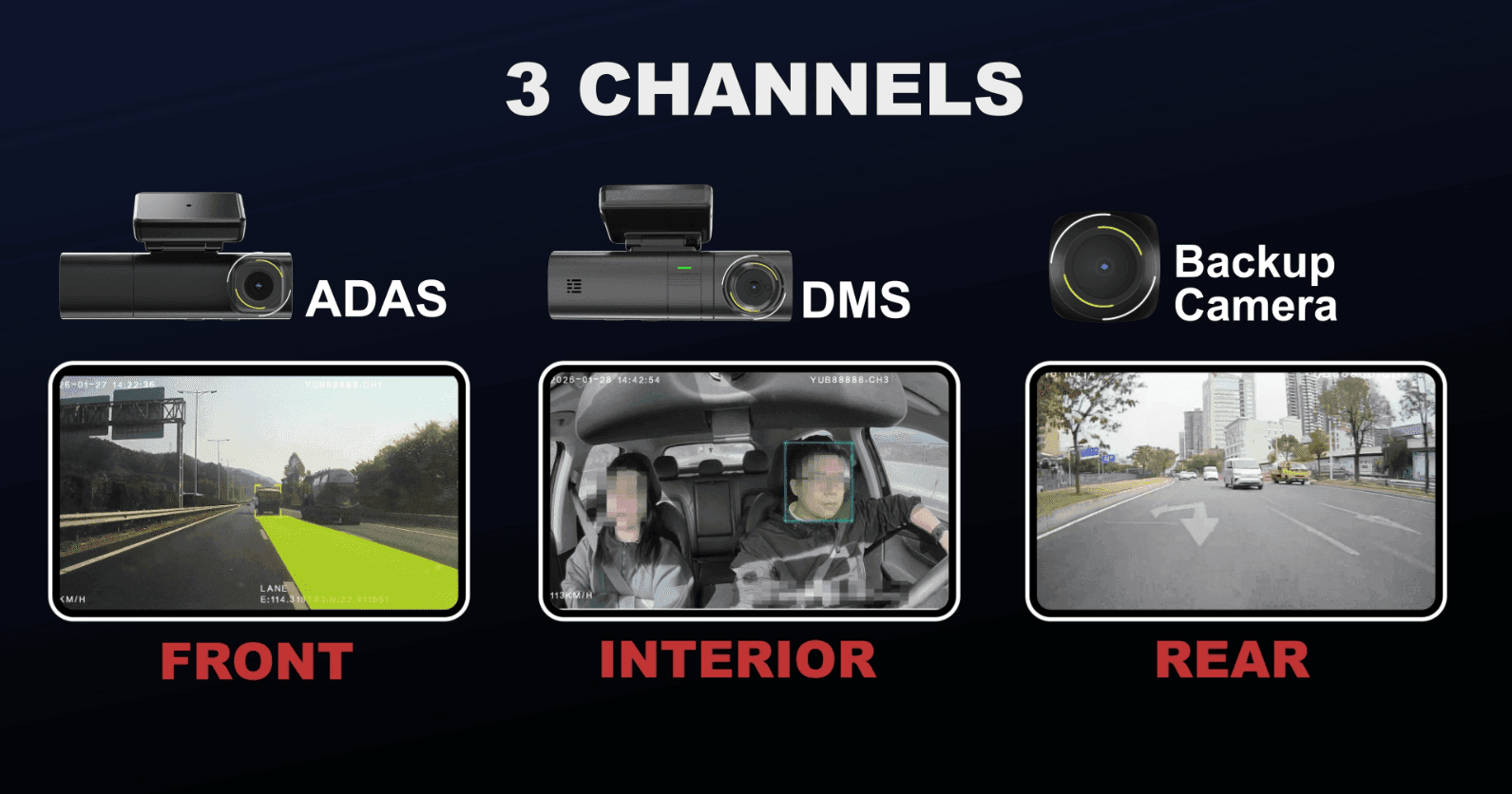
A 3 channel dashcam can support different monitoring needs through multiple camera views. BSJ’s DR03 supports up to three channels, allowing a fleet to combine a forward-facing road view with in-cabin monitoring and an optional external camera. The camera arrangement should reflect the vehicle type, operating environment, and monitoring objective.
AI functions can help identify several types of driving risk. Advanced Driver Assistance Systems (ADAS) can provide warnings related to forward collision risks, lane departure, and unsafe following distances. Driver Monitoring Systems (DMS) can identify signs associated with fatigue or distraction. These functions provide information for safety reviews.
Which driver and road conditions should fleet teams monitor?
The most useful monitoring functions depend on the risks associated with each fleet operation. Long-distance transport may place particular emphasis on fatigue and following distance. Urban delivery vehicles may encounter frequent lane changes, congestion, and sudden braking, making road-facing alerts relevant to daily operations.
A monitoring plan can begin with three areas:
A system that generates alerts is not a substitute for driver training, vehicle maintenance, or a documented safety policy. It is one source of information that can support those activities.
How should camera alerts fit into fleet management?
An alert is most useful when it leads to a clear operational response. Fleet managers should establish who reviews alerts, how events are prioritized, and when a driver conversation or further investigation is appropriate. Without an agreed process, teams may collect footage without consistently acting on the information.
A practical workflow can include reviewing an alert, checking the related footage, recording the outcome, and deciding whether follow-up is needed. Managers can look for repeated patterns across routes or vehicles.
A dash cam with live gps tracking can bring video monitoring together with location information. When evaluating a dash cam with live gps tracking, buyers should check how video and positioning data are presented in the fleet system. Location context can help reviewers understand where an event occurred and relate it to a route or vehicle activity.
The DR03 supports 4G LTE connectivity and multi-constellation GNSS positioning, including GPS, Galileo, BeiDou, and GLONASS. Availability depends on network coverage and configuration.
What should buyers check before choosing an AI dashcam?
Specification review should go beyond the number of camera channels. Buyers need to confirm that the device supports the required camera layout, AI functions, connectivity, and installation conditions for their vehicles.
| Evaluation area | Questions to consider |
| Camera coverage | Are forward, cabin, and optional external views required? |
| AI functions | Do the supported ADAS and DMS alerts match the fleet’s risk priorities? |
| Connectivity | Is cellular connectivity suitable for the operating areas? |
| Positioning | Does the GNSS support meet location-monitoring requirements? |
| Deployment | Can the device be installed and configured across the vehicle types? |
The DR03 product information lists an AI NPU, ADAS and DMS functions, 4G LTE CAT.4 connectivity, and a 9–90V input range. These details support compatibility checks. Teams should also confirm wiring, camera placement, power conditions, and integration requirements for each vehicle model.
A pilot installation can help validate these choices. Testing the system on representative vehicles allows installers and fleet supervisors to check camera views, alert relevance, connectivity, and the workload involved in reviewing events. Driver feedback may identify adjustments before wider rollout.
Turning detection into a consistent safety process
AI camera technology can help fleet operators identify selected driver and road risks, but its contribution depends on suitable installation and a defined response process. Matching camera coverage and alert functions to actual operating conditions makes monitoring more relevant to daily fleet management.
For commercial projects, BSJ Technology offers AI dashcam and fleet telematics products for fleet applications. Project teams can review the available device information against their vehicle requirements, monitoring priorities, and integration plans before selecting a configuration.

BSJ Technology (SZSE: 301608) is a global provider of AI Video Telematics and Connected Fleet IoT solutions. Since 2009, BSJ has developed AI Dashcams, MDVR systems, and GPS tracking solutions for commercial fleets worldwide.