We're here to help. Reach out for any inquiries about our products, services, or partnerships.
Choose your operating system to start
Commercial vehicles often operate in environments where drivers need to monitor several areas at once. Trucks may have limited rear visibility, buses require different monitoring arrangements, and engineering vehicles can move around workers and equipment. For fleet operators, multi-channel video helps provide more context when reviewing road events and vehicle activity.
At BSJ Technology, we develop AI video telematics devices for commercial fleet applications. Our ED02R-V2 combines four-channel HD video recording with AI-supported safety functions. When evaluating a 4 channel mobile dvr, fleet managers should consider how camera coverage, intelligent alerts, and remote video access fit their daily operations.
Why Is Multi-Channel Recording Useful for Commercial Vehicles?
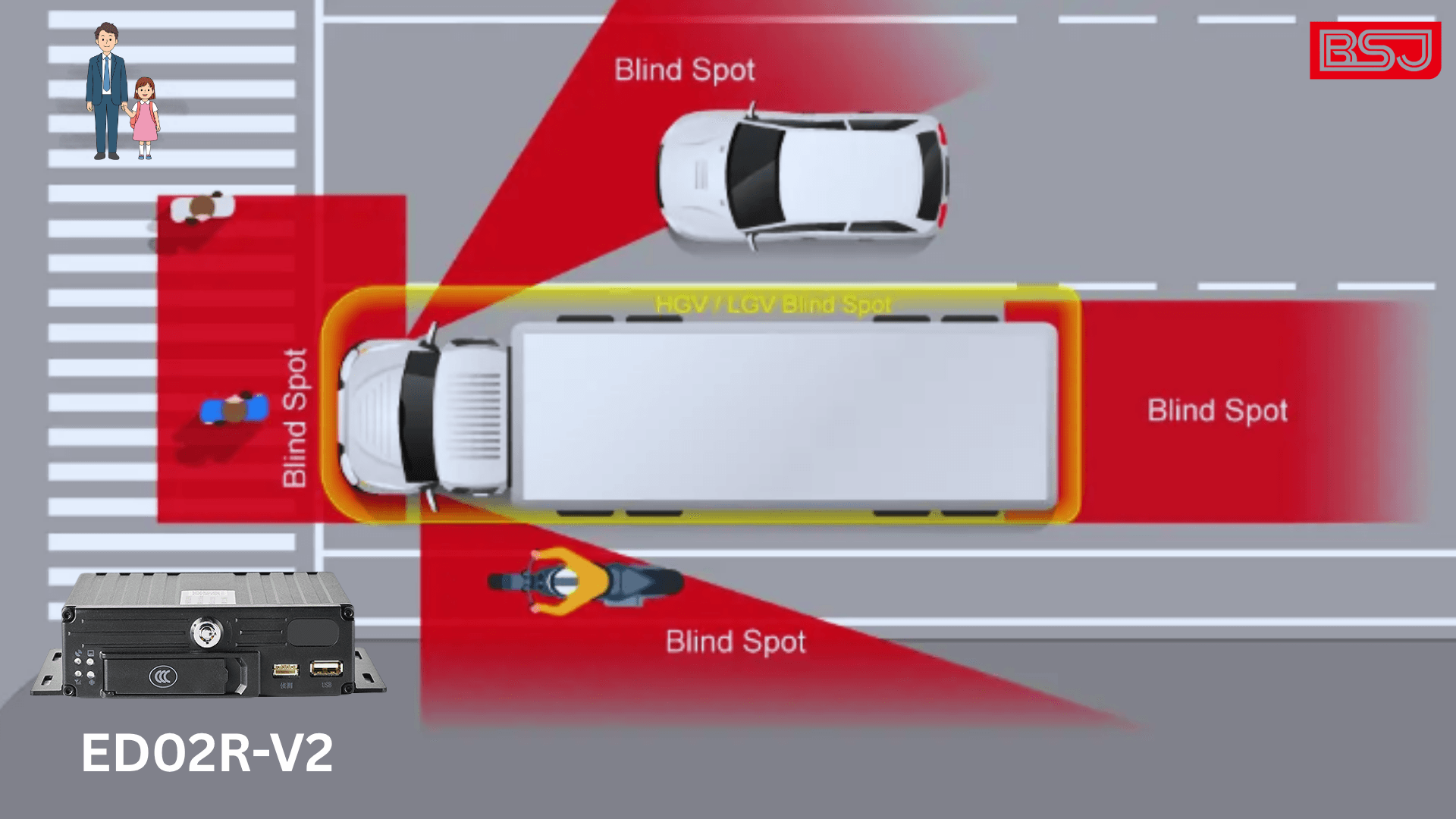
A single camera view cannot cover every area around a large vehicle. A front-facing camera records road conditions ahead, but it does not necessarily show activity beside the vehicle, behind it, or inside the cabin.
A four-channel system allows several camera views to be collected through one in-vehicle recording unit. Camera positions can be planned according to vehicle structure and monitoring priorities. Logistics operators may focus on front, rear, and side views, while public transport companies may also need visibility into selected interior areas.
For construction and engineering fleets, camera placement should take account of vehicle movement and nearby workers. The goal is to capture useful visual information for incident review and operational supervision, rather than simply installing as many cameras as possible.
Before deployment, fleet teams should identify which areas require monitoring and confirm that the selected camera arrangement is compatible with each vehicle type.
How Does AI Make Multi-Channel Video More Useful?
Multi-channel recording provides different camera views, while AI functions help identify specific events within the monitored environment. Combining these capabilities allows fleet operators to obtain both visual records and alerts related to selected driving conditions.
Our ED02R-V2 integrates ADAS, DMS, and BSD functions to address different monitoring requirements. ADAS focuses on road conditions ahead, DMS monitors driver behavior, and BSD uses multi-angle AI vision to detect nearby vehicles, cyclists, and pedestrians in monitored blind-spot areas. These functions complement the device's four-channel HD recording capability.
For fleet managers, this combination provides more context when reviewing vehicle safety events. Relevant alerts can help supervisors identify footage for further examination, understand the circumstances surrounding an event, and determine whether driver training or adjustments to vehicle operations are appropriate.
What Should Buyers Check When Choosing a 4G LTE MDVR?
Connectivity is an important consideration when a fleet needs remote video access. A 4g lte mdvr can form part of a connected monitoring setup, allowing video and device information to be accessed through a compatible management platform.
However, network capability should not be the only selection criterion. Buyers should also review camera inputs, recording requirements, installation conditions, and platform compatibility. The ED02R-V2 supports four-channel HD video collection at 1080P or 720P, together with real-time uploads, playback, and access to historical footage.
Before procurement, fleet operators and system integrators should consider:
A 4g lte mdvr should be assessed as part of the wider fleet monitoring solution. Reviewing these details before installation helps project teams plan a more suitable deployment.
How Can Remote Management Support Fleet Operations?
After installation, devices still require configuration, maintenance, and technical support. These responsibilities can become more complex when equipment is distributed across vehicles and operating locations.
BSJ provides tools that support device management. The Configurator helps users configure compatible devices, while FOTA Web supports remote firmware updates and maintenance. These capabilities can help technical teams manage supported equipment without relying entirely on individual on-site visits.
Fleet operators should also establish clear procedures for reviewing alerts, accessing recorded footage, and handling technical issues. Drivers and supervisors need to understand their respective responsibilities, while system integrators should consider how device management fits into the customer's existing platform.
A defined process makes it easier to maintain consistent equipment settings and coordinate support as the deployment expands.
Bringing AI Video Into Fleet Safety Management
A multi-channel MDVR can support fleet safety by combining several camera views with AI-assisted monitoring. The selection process should begin with vehicle-specific requirements, followed by checks on recording, connectivity, platform compatibility, and ongoing maintenance.
Our ED02R-V2 brings four-channel HD recording together with ADAS, DMS, and BSD functions for commercial fleet applications. At BSJ Technology, we provide AI video telematics hardware for fleet operators, distributors, and system integrators, with solutions designed to support different commercial vehicle projects.

BSJ Technology (SZSE: 301608) is a global provider of AI Video Telematics and Connected Fleet IoT solutions. Since 2009, BSJ has developed AI Dashcams, MDVR systems, and GPS tracking solutions for commercial fleets worldwide.