Choose your operating system to start
Trucks, vans, and buses operate under very different conditions, but they share one basic fleet management requirement: operators need reliable visibility into vehicle movement. Knowing where vehicles are, reviewing routes, receiving alerts, and connecting vehicle activity with a management platform can make day-to-day operations easier to control.
A GPS tracker is the hardware foundation for this visibility. However, selecting a device for a commercial fleet requires more consideration than simply checking whether it can provide coordinates. Power configuration, connectivity, installation method, alarm functions, vehicle compatibility, and integration capabilities can all influence how useful the tracking system becomes in practice.
We develop GPS tracking devices for commercial fleet and asset applications, with different hardware configurations designed around different operating requirements.
At its most basic level, a tracker determines vehicle position through satellite positioning and communicates that information to a remote platform. Fleet personnel can then use the resulting data for real-time monitoring and historical route review.
Our GPS tracker portfolio includes wired, wireless, rechargeable, and other specialized devices. This variety allows the tracking hardware to be selected according to the vehicle and deployment scenario rather than applying the same device to every asset.
For example, the KG-22 is a wired 4G vehicle positioning terminal designed for fleet, rental, taxi, and vehicle applications. It supports real-time tracking and includes alerts related to events such as overspeed, collision, rollover, and harsh driving. It also has IP67 protection.
For a GPS tracker device, these additional functions can make the hardware more useful than a location-only terminal.
Heavy trucks often travel long distances and may operate across highways, industrial areas, construction sites, or other demanding environments. Fleet managers may therefore need location information together with driving and vehicle-status events.
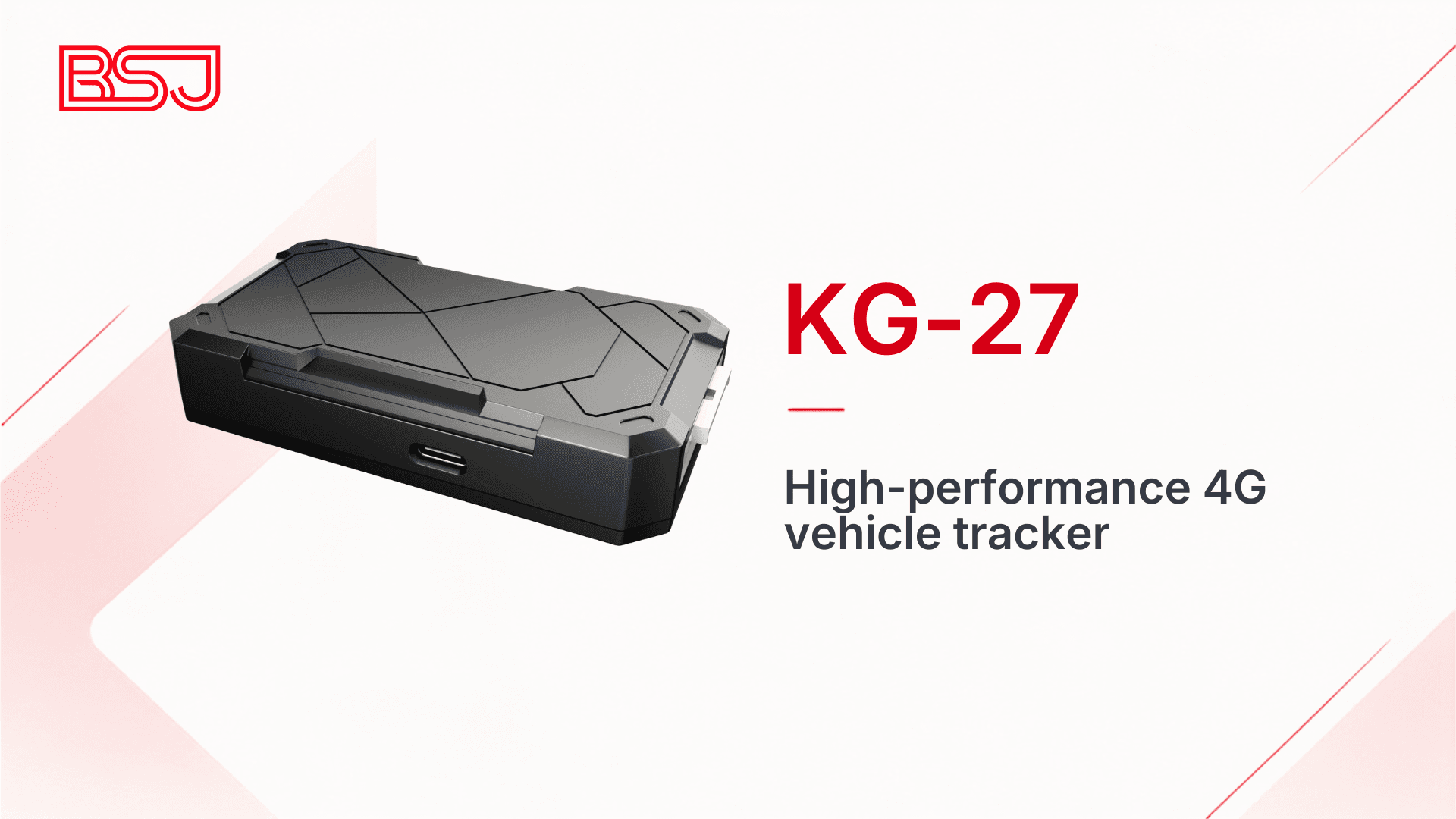
Our GPS tracker range includes devices suitable for commercial vehicles with different installation and power requirements. The KG-27, for instance, is a 4G vehicle GPS tracker with LoRa connectivity, a 9–90V voltage range, remote fuel cut-off control, RS232 connectivity, and alarm functions for speeding, low voltage, vehicle power failure, and collisions.
This type of multifunctional tracker can connect location monitoring with additional vehicle-management requirements. Through its RS232 interface, the KG-27 can also connect with external devices such as fuel-level, temperature and humidity, RFID, and door sensors.
The right choice depends on which vehicle information the fleet actually needs to collect.
Delivery vans and light commercial vehicles may have different priorities. Some fleets need permanent wired tracking, while others require equipment that can be installed without extensive vehicle modification.
A rechargeable tracker can be useful for applications where permanent wiring is inconvenient. Our EG80G, for example, is a 4G rechargeable GPS tracker with a 7,500mAh battery, magnetic mounting, IP68 protection, and multiple operating modes. It is designed for wire-free vehicle and asset tracking and can also be used with trailers, construction equipment, rental assets, and other mobile assets.
This illustrates why hardware selection should begin with the operating environment. A delivery fleet with frequently changing vehicles may approach installation differently from a permanently assigned truck fleet.
Buses follow scheduled routes and often operate repeatedly throughout the day. For these fleets, tracking can support continuous visibility over vehicle locations and movement history.
A fleet GPS tracker system can provide the foundation for monitoring multiple vehicles through a shared management environment. Instead of treating every bus independently, fleet personnel can review vehicle activity across the wider operation.
The tracking hardware can also work alongside other telematics equipment. BSJ's commercial portfolio includes GPS trackers, AI dashcams, and MDVR systems, allowing operators to select tracking as a standalone function or as part of a broader connected fleet architecture.
Location information becomes more actionable when the system can identify events that require attention.
Depending on the tracker model, BSJ devices support different alerts and functions. The KG-22 supports overspeed, collision, rollover, and harsh driving alerts, while the KG-27 adds functions such as low-voltage and vehicle-power-failure alerts. The C02G combines real-time vehicle tracking with multiple alarm notifications, low-power sleep mode, and ignition detection.
These features allow fleet managers to focus on exceptions instead of continuously observing every vehicle.
GPS positioning and communication are separate parts of the tracking process. The device first determines its position, then transmits relevant information through an available communications network.
Our product range includes 4G devices using technologies such as LTE Cat.1, while some models also provide additional communication methods for specific applications. The appropriate choice depends on operating region, required reporting behavior, power constraints, and the type of data being transmitted.
Remote management is another consideration for larger deployments. BSJ's fleet platform includes device configuration and FOTA capabilities, supporting remote parameter management and firmware updates.
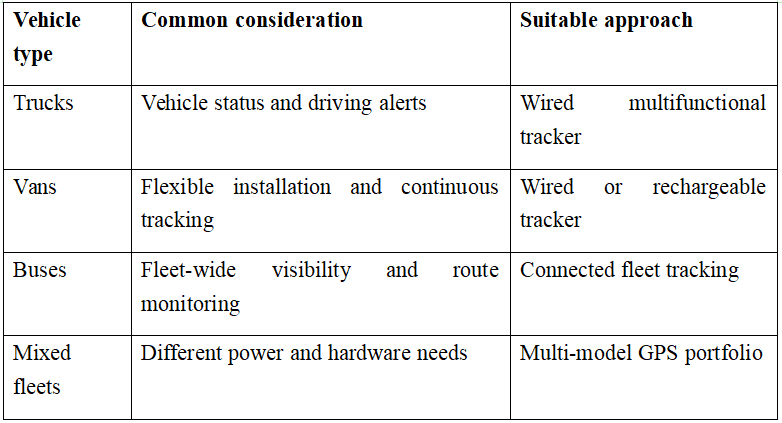
The important point is that one specification does not define the suitability of a tracker. Fleet size, vehicle type, installation conditions, communications, and required alerts should all be considered together.
We design our GPS tracker portfolio so that different devices can address different vehicle and asset requirements while fitting into a broader telematics ecosystem. This also allows tracking hardware to work alongside other BSJ technologies when a fleet needs expanded monitoring capabilities.
At BSJ, our robust fleet GPS tracker system delivers GPS tracking hardware and connected fleet technologies for commercial applications. Our portfolio includes wired vehicle trackers, rechargeable tracking devices, and multifunctional terminals with different connectivity, alarm, power, and integration options.
For trucks, vans, and buses, the most effective tracking solution is therefore not necessarily the device with the longest feature list. It is the one whose hardware, communication method, installation approach, alert functions, and fleet-management capabilities align with the vehicle's actual operating environment.

BSJ Technology (SZSE: 301608) is a global provider of AI Video Telematics and Connected Fleet IoT solutions. Since 2009, BSJ has developed AI Dashcams, MDVR systems, and GPS tracking solutions for commercial fleets worldwide.