Choose your operating system to start
A commercial vehicle can appear online on a tracking map while its dashcam remains disconnected, its latest safety event has not uploaded, or its device configuration differs from the rest of the fleet. For telematics providers, these gaps create a practical problem: collecting vehicle data is not the same as making that data usable across daily operations.
A fleet tracking platform needs to connect vehicle positions, operational events, video records, and device status within a coherent data workflow. The challenge is especially relevant to platform providers and system integrators managing different vehicle types, hardware models, and customer requirements.
Every connected vehicle generates information through its installed devices. GNSS trackers report position, while cameras record road conditions and may generate AI-based safety events. Other supported interfaces can provide selected vehicle parameters or device-health information.
The platform must associate these records with the correct vehicle, timestamp, and device. Otherwise, a location update may be difficult to correlate with a video event, particularly when vehicles are reassigned or hardware is replaced.
Our work at BSJ Technology focuses on the vehicle hardware layer behind these workflows. We develop and manufacture tracking devices, AI dashcams, and mobile digital video recorders (MDVRs), giving telematics partners hardware options for different connected-fleet configurations. Device selection should follow the data the application needs, rather than assuming every vehicle requires identical equipment.
A vehicle stopping outside its planned route is a signal, not a complete explanation. The stop could reflect traffic congestion, a delivery delay, an inspection, or a mechanical issue. Location history helps establish where and when it happened, but additional information may be needed to determine the appropriate response.
A fleet tracking platform can combine position reports with timestamps, geofence events, route history, and available vehicle data. If a compatible camera records the same period, authorized users can review the relevant footage alongside the vehicle's movement. This reduces the need to investigate each information source independently.
Reliable correlation depends on consistent identifiers and time records. Integrators should establish how the system handles delayed messages, missing location reports, and vehicles with multiple connected devices. A well-defined data model makes operational records easier to interpret without presenting incomplete information as a confirmed event.
Location data identifies where a vehicle traveled; video reveals what the camera captured around a particular event. Combining these sources can help fleet managers investigate collisions, review driver behavior, and understand incidents that require follow-up.
An AI video telematics platform may add Advanced Driver Assistance Systems (ADAS) and Driver Monitoring Systems (DMS), depending on the camera hardware and configuration. Supported functions can include alerts for lane departures, unsafe following distances, or indicators of driver fatigue and distraction. Actual detection capabilities vary by model, installation, and operating conditions.
The integration must extend beyond displaying an alert. Users need access to associated timestamps, vehicle information, and relevant recordings, subject to permissions and retention settings. Event priorities and review procedures should also be defined so that important alerts receive attention without overwhelming operators with unhelpful notifications.
Fleet operations rarely remain static. Vehicles enter service, devices require replacement, firmware changes become necessary, and customer configurations evolve. Without structured device administration, technical teams may struggle to identify configuration differences or troubleshoot inconsistent reporting across a growing deployment.
Remote configuration and firmware-over-the-air (FOTA) tools can simplify supported maintenance tasks. They may allow authorized teams to manage device parameters or distribute compatible firmware without accessing every vehicle physically. However, update support, rollback behavior, and configuration options depend on the device and management system.
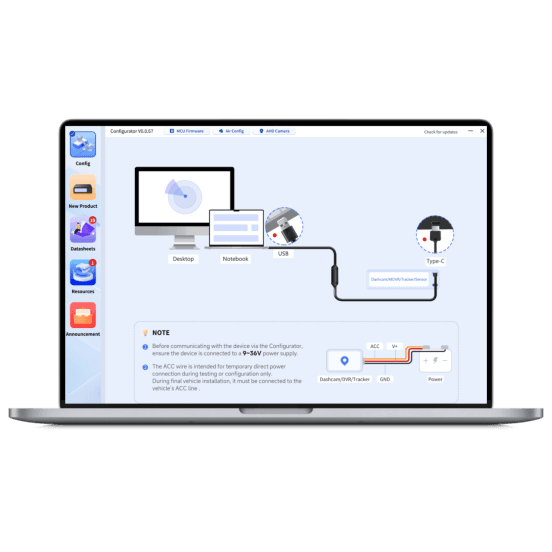
We at BSJ Technology provide device-management tools, including the BSJ Configurator for compatible device setup and a FOTA web platform for remote firmware management. For telematics businesses, these capabilities are relevant because device administration is part of maintaining the connected fleet, not merely a task completed during installation.
Fleet technology providers often have established applications for dispatch, customer reporting, maintenance, or subscription management. Adding connected vehicle hardware should not automatically require rebuilding those applications.
An integration project begins by defining which system owns each function. The tracking application may manage vehicle positions, while another platform handles customer accounts or maintenance records. Interfaces must then specify how device identifiers, event types, timestamps, and video references move between systems.
An AI video telematics platform may provide its own monitoring interface or supply device data to a third-party application. Neither model is universally preferable. The right choice depends on existing infrastructure, required workflows, supported protocols, and the resources available for integration and maintenance.
We work with telematics platform providers, system integrators, and OEM/ODM customers to assess hardware configurations and project-specific integration requirements. Protocol support and customization should be confirmed against the target application before deployment; compatibility with one interface does not guarantee that every feature will work across every platform.
A successful demonstration may prove that a device can report its position, but it does not establish that the complete deployment is ready. A pilot should follow information from the vehicle through the communication network into the target application and verify that users can retrieve and interpret the resulting records.
Test representative vehicle types and realistic operating conditions. Check location reporting, video-event correlation, device-status visibility, remote configuration, and recovery from communication interruptions where applicable. Confirm how delayed uploads appear in the interface and whether records remain associated with the correct vehicle after a device replacement.
Document acceptance criteria before expanding the rollout. Assign responsibility for hardware troubleshooting, platform-side errors, firmware changes, and data discrepancies. These boundaries reduce uncertainty when multiple suppliers contribute to the same connected-fleet solution.
The value of connected fleet technology depends on whether its data supports actual operational decisions. Dispatchers need reliable location information, safety teams need relevant event evidence, and technical administrators need visibility into device configuration and status. Bringing these functions together requires coordinated hardware, defined data relationships, and tested interfaces.
We bring together in-house hardware development, manufacturing expertise, and integration support to help telematics partners address real-world deployment requirements. Starting with clear data requirements and validating device-to-platform communication helps ensure that each component serves a defined operational purpose as the connected fleet grows.

BSJ Technology (SZSE: 301608) is a global provider of AI Video Telematics and Connected Fleet IoT solutions. Since 2009, BSJ has developed AI Dashcams, MDVR systems, and GPS tracking solutions for commercial fleets worldwide.