Choose your operating system to start
A fleet dashcam is no longer limited to recording the road ahead. For commercial operators, an intelligent camera can connect driver behavior, road conditions, vehicle location, and incident footage within a broader telematics environment. This creates two practical functions: helping fleets respond to unsafe driving while preserving evidence when an incident occurs.

We develop AI video telematics equipment for commercial fleets, including multi-channel dashcams that combine video recording, driver monitoring, road-risk detection, connectivity, and positioning. The technology is designed to support fleet safety and operational visibility without separating video from the rest of the vehicle data.
A conventional dashcam primarily records video. An AI-enabled device adds algorithms that can interpret selected events and generate information for fleet management.
Our fleet AI dashcam portfolio includes devices designed for commercial fleet safety and video telematics. Depending on the model, capabilities include Advanced Driver Assistance Systems (ADAS), Driver Monitoring Systems (DMS), multi-channel video recording, cellular connectivity, GNSS positioning, and remote device management.
This distinction is important for driver coaching. A manager does not necessarily need hours of footage every day. What matters more is identifying relevant events and creating a record that can be reviewed with the driver or used for further investigation.
Driver coaching is more effective when it is based on identifiable driving behavior instead of assumptions. AI-enabled cameras can flag specific events that may indicate elevated risk.
The BSJ DR03, for example, integrates ADAS and DMS algorithms. Its safety functions can detect collision risks, lane departures, unsafe following distances, driver fatigue, and distraction.
These alerts can provide a practical starting point for coaching. Instead of telling a driver simply to “drive more carefully,” fleet teams can review a particular event, discuss the associated behavior, and identify improvements.
This also allows safety management to move from occasional manual reviews toward a more consistent process based on recorded events.
AI detection does not replace video recording. When a collision, unsafe maneuver, or other significant event occurs, recorded footage can provide context that an alert alone cannot offer.
The DR03 supports up to three camera channels, covering the forward road view, in-cabin monitoring, and an optional external camera depending on configuration. It records high-definition video using H.264 encoding.
Multiple camera views can therefore help answer different questions after an incident. The forward camera can show road conditions, while an interior or external camera can provide additional information about driver behavior or surrounding activity.
For commercial operators, this can be useful when reviewing collisions, disputed events, or other safety-related situations.
Not every vehicle requires the same camera arrangement. A small delivery vehicle may have different monitoring priorities from a heavy truck or passenger transport vehicle.
Our AI dashcam range includes different configurations for commercial applications. The EH15-V2, for example, supports both six-channel and four-channel recording configurations, including combinations of 1080P and 720P cameras. It also supports ADAS and DMS, GPS tracking, 4G CAT.4 communication, two-way communication, and remote positioning and trajectory playback.
This flexibility allows camera coverage to be matched to vehicle layout and fleet objectives instead of applying one configuration universally.
Recorded footage becomes more useful when important information can reach the fleet management environment.
Our truck AI dashcam lineup incorporates cellular communication and GNSS positioning on relevant models. The DR03 uses 4G LTE CAT.4 and supports GPS, Galileo, BeiDou, and GLONASS.
Connectivity allows selected events and vehicle information to be transmitted for remote monitoring and review. It also means the dashcam can participate in a larger telematics architecture rather than functioning only as local storage.
For fleet managers, this can reduce the need to retrieve memory cards or physically access vehicles whenever important information needs to be reviewed.
A dashcam deployment does not end when the hardware is installed. Fleet operators may need to configure devices, change parameters, update firmware, or maintain equipment across many vehicles.
We support remote management through tools such as BSJ Configurator and FOTA Web. These capabilities help fleet teams configure devices and perform firmware updates remotely, which becomes particularly valuable when vehicles operate across multiple locations.
Remote management also helps maintain consistency. Instead of handling every vehicle individually, fleet teams can manage equipment through a more centralized process.
A useful dashcam strategy should connect detection, review, and action.
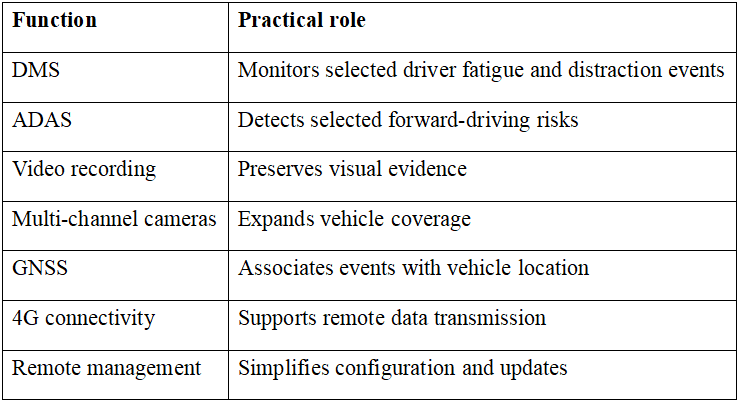
For truck operators specifically, a truck AI dashcam can combine these capabilities to provide a more complete picture of vehicle operation. The appropriate configuration still depends on vehicle type, camera requirements, connectivity, and the safety events the fleet needs to monitor.
The strongest value of AI video technology comes from using the information after an event has been identified. A recorded incident can support investigation, but repeated events can also reveal patterns in driver behavior.
For example, recurring fatigue or distraction alerts may indicate a need for additional coaching or management attention. Repeated road-risk events may suggest that certain driving situations require closer review.
At BSJ Technology, we combine AI dashcams, GPS tracking, video capabilities, and connected fleet technologies for commercial applications. Our approach is to make driver monitoring and incident evidence part of a broader vehicle telematics framework.
For fleet operators, the key question is therefore not simply whether a dashcam can record an accident. A more useful system should help identify relevant driving risks, preserve supporting video, associate events with vehicle information, and give fleet teams practical tools for reviewing and responding to those events.

BSJ Technology (SZSE: 301608) is a global provider of AI Video Telematics and Connected Fleet IoT solutions. Since 2009, BSJ has developed AI Dashcams, MDVR systems, and GPS tracking solutions for commercial fleets worldwide.