Choose your operating system to start
Urban delivery fleets work through dense routes, short stops, customer time windows, traffic disruption, and frequent changes in workload. For dense urban routes, a van fleet management system should help dispatchers identify exceptions without requiring constant phone calls to drivers. Live position, route history, geofence events, driver-safety data, video evidence, and vehicle status become useful when they are tied to specific jobs and response rules.
For commercial delivery operations, the technology also has to remain economical across a high vehicle count. Installation time, network usage, remote management, software integration, and support effort can matter as much as the tracker specification itself. A design that works on five vans but requires frequent manual intervention may become expensive once several cities, contractors, or depots are involved.
Frequent location updates help the control room see whether a van is moving, waiting, delayed, or outside an expected service area. A small-van configuration can use 4G-connected tracking with sub-10-second location updates on suitable hardware. Buyers should still define the operational interval they need because higher frequency can increase communication cost without improving every workflow. Route history and geofences can support more than live mapping.
Delivery teams may need evidence of arrival, departure, restricted-zone entry, missed areas, or unplanned stops. When those records are associated with jobs or customer time windows, dispatch can investigate recurring delay points and customer-service teams can answer questions with a consistent trip record. A delivery fleet management workflow should emphasize exceptions rather than continuous observation.
A late departure, prolonged stop, route deviation, or vehicle entering an unauthorized zone can trigger review according to business rules. Different routes may need different thresholds, because a five-minute delay on a flexible route does not carry the same consequence as the same delay on a tightly sequenced urban schedule. Vehicle diversity affects installation.
Small vans can have limited cabin space, different power layouts, and windscreen areas already occupied by other equipment. Technicians should document device position, antenna location, cable routing, ignition behavior, and commissioning steps so the fleet can add vehicles without creating inconsistent installations that later complicate troubleshooting.
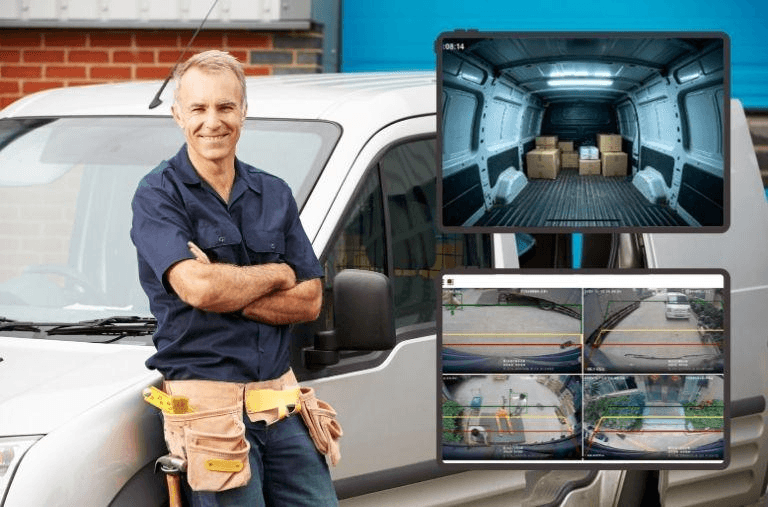
AI video can explain why a route or safety exception occurred. Our camera options can apply ADAS and DMS functions to behaviors such as drowsiness, phone use, seatbelt violations, tailgating, or lane departure when supported by the selected device. Delivery-fleet policy should determine which events justify immediate warning, later coaching, or no action after human review. In delivery projects, we at BSJ Technology link camera evidence with vehicle and route context.
A harsh maneuver near a customer site may have a different meaning from the same event at highway speed. When timestamps, GPS data, and video are synchronized, safety reviewers can distinguish avoidable behavior from traffic conditions and use evidence more fairly during coaching or incident investigation. Cargo and customer disputes may also justify visual coverage. Road-facing, cabin, cargo, or external views can document collisions, loading activity, unauthorized access, or disputed events.
The fleet should define who may retrieve clips, how long they are retained, and when video is appropriate, especially where drivers or customers may be recorded during normal delivery work. Vehicle-health and maintenance data can protect delivery capacity.
A van that repeatedly misses jobs because of a device fault or vehicle issue creates operational cost even when routing is well designed. Maintenance reminders and remote device-health visibility help teams identify problems earlier, while field inspection remains necessary for wiring, cameras, antennas, and physical damage.
Scale changes the economics of every manual step. Once the van fleet scales, remote configuration, firmware management, device naming, and status visibility become valuable across several depots. Common profiles reduce the risk that local teams create different alert thresholds or reporting behavior, and they give technical support a known baseline when a unit behaves unexpectedly. Integration with an existing dispatch or order system can make location data more actionable.
A distributor or operator may prefer to keep its own customer-facing software while using our hardware underneath. Open protocol support allows that architecture to be evaluated without forcing a full platform replacement, provided the pilot verifies identifiers, event messages, commands, and timing under real route conditions. A phased deployment is usually easier to control than a single large installation. The first group should represent different van models, route densities, driver patterns, and network environments.
The first van deployment wave should record fitment effort, location continuity, useful exceptions, evidence retrieval, network use, remote administration, and support workload before those lessons are converted into a standard kit for later vehicles. These results also show whether delivery fleet management procedures need different alert rules for dense city routes and lower-frequency suburban work.
Urban fleets gain value from tracking when the system reduces the number of exceptions that staff have to investigate manually. For our delivery projects at BSJ Technology, we connect a van fleet management system with GPS, AI video, remote device control, and third-party software integration so route events can flow into the operator's existing process.
Delivery fleet management still depends on disciplined installation and alert design because dense city work generates many short stops and changing conditions. We use phased pilots to measure fitment time, connectivity, event usefulness, video retrieval, and support effort across different van models. Those results can then be converted into a standard kit and configuration profile, giving later deployment waves a consistent technical baseline instead of relying on local installer judgment.

BSJ Technology (SZSE: 301608) is a global provider of AI Video Telematics and Connected Fleet IoT solutions. Since 2009, BSJ has developed AI Dashcams, MDVR systems, and GPS tracking solutions for commercial fleets worldwide.