Choose your operating system to start
A delivery dashboard can display vehicle locations, planned stops, and reported events, but its usefulness depends on the information arriving from the vehicles. If a driver misses a delivery, a customer disputes an incident, or dispatch needs to investigate an unexpected detour, software cannot reconstruct details that the onboard equipment never captured.
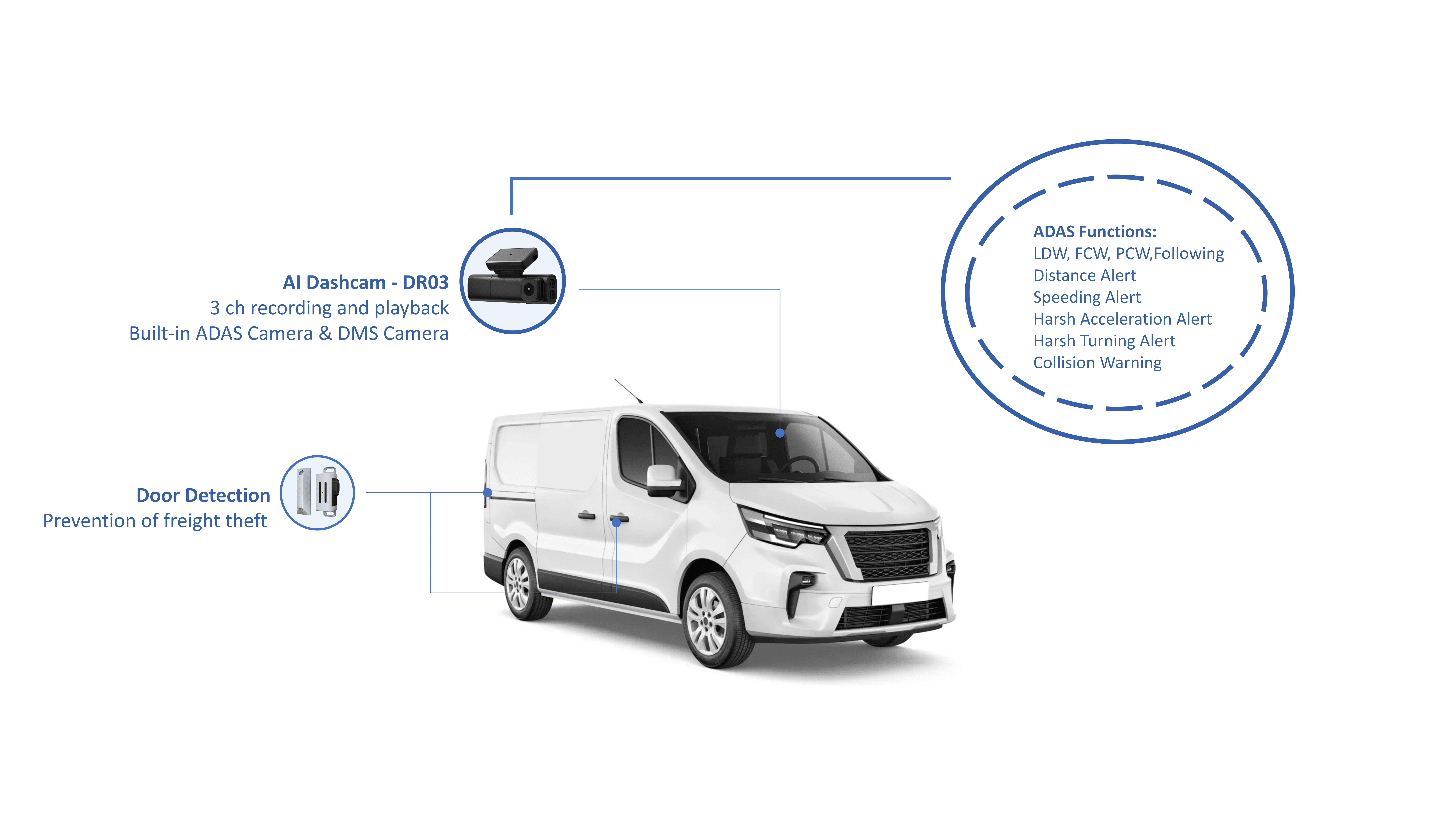
We approach delivery fleet management as a connection between physical vehicles and digital workflows. The software organizes information and presents it to users; tracking devices, cameras, and other onboard hardware determine which information can be collected in the first place.
Fleet management software can organize routes, display reports, and coordinate dispatch activities when the necessary data is available. However, it does not independently measure a vehicle's position or record events outside the vehicle. Those tasks depend on connected hardware and its supported functions.
Consider a delivery van that arrives late at a customer location. A software dashboard might show the delay, but the reason could be congestion, an incorrect address, an unauthorized stop, or a vehicle problem. Reliable delivery fleet tracking provides location history for investigation, while additional device inputs may help distinguish between possible explanations.
Hardware therefore determines the depth of operational visibility. A basic tracker may satisfy a location-focused deployment, whereas a fleet handling frequent disputes or safety incidents may need video recording and event detection as well.
Last-mile delivery involves repeated journeys between depots, customer addresses, collection points, and other designated locations. Dispatchers need current vehicle positions and historical records to understand whether planned journeys are progressing as expected.
GNSS-enabled GPS trackers supply positioning data that compatible software can display as live locations or route histories. Configured geofencing can generate notifications when vehicles enter or leave designated areas, provided the device and platform support the function. These records help dispatchers investigate missed stops, unexpected detours, and unusual vehicle movements.
A suitable van tracking system should therefore be evaluated against the operational workflow, not simply the presence of a map. Buyers should check location-reporting behavior, historical data availability, connectivity requirements, and how exceptions appear in their existing application.
The distinction matters particularly for platform providers. If device reporting intervals, timestamps, or vehicle identifiers are inconsistent with the software's assumptions, route histories and alerts may become difficult to interpret. Testing actual data exchange is more useful than judging integration from a demonstration screen alone.
Location records show where a vehicle traveled, but they cannot independently explain every road event or delivery dispute. A customer may report vehicle damage, a driver may encounter a collision, or a safety manager may need to review a potentially risky maneuver. These situations require evidence beyond coordinates.
AI dashcams add visual information, while supported Advanced Driver Assistance Systems (ADAS) and Driver Monitoring Systems (DMS) can provide alerts for selected driving risks or driver behaviors. Camera placement and recording configuration determine which events can be reviewed afterward.
For delivery fleet tracking, connecting a video event with its timestamp and vehicle record makes investigation more practical. Operations teams can locate relevant footage and compare it with the corresponding journey, subject to device capabilities, connectivity, and recording availability.
A van tracking system equipped with suitable video hardware can therefore serve a broader purpose than position monitoring. Nevertheless, recording does not guarantee that every incident will be captured clearly. Camera coverage, storage settings, power supply, and access procedures all affect the evidence available.
Information must travel from the vehicle to the application before a dispatcher can act on it. Depending on the configuration, the chain may involve GNSS positioning, onboard event processing, cellular connectivity, a communication protocol, and the receiving platform.
Failures can occur at different points. A device may record an event without uploading it immediately; network coverage may delay transmission; or a platform may receive data that it cannot correctly associate with a vehicle. Troubleshooting requires checking the entire data path rather than assuming that every missing alert is a software defect.
At BSJ Technology, we develop vehicle telematics hardware, including GPS trackers, AI dashcams, and MDVR systems, for connected fleet applications. Our integration approach supports customers who need to connect compatible devices with existing telematics platforms rather than rebuild their entire software environment.
Before deployment, integrators should verify supported protocols, required data fields, video retrieval methods, and device configuration options. Remote firmware and configuration management can also simplify maintenance across distributed fleets when supported by the selected equipment.
Start with the operational decisions the platform must support. If dispatch mainly needs vehicle positions and route history, tracking hardware may be sufficient. If the business also needs incident evidence or driver-event alerts, the specification should include compatible video and safety functions.
For delivery fleet tracking projects, pilot installations should test real routes, network conditions, event reporting, and historical record retrieval. Teams should confirm that alerts reach the right users and that available evidence answers the questions that prompted the deployment.
A van tracking system should also fit the vehicle's installation constraints and the platform's integration requirements. Distributors and system integrators may need OEM/ODM customization to address particular interfaces, product configurations, or deployment environments. Such requirements should be agreed upon before production or rollout.
The key decision is not whether software or hardware matters more. Software turns incoming data into operational workflows, while hardware supplies the observations those workflows depend on.
At BSJ Technology, we help B2B customers build that connection around their fleet requirements, with hardware options and integration support designed for practical deployment. Choosing both layers together gives delivery operators a clearer basis for investigating exceptions, reviewing safety events, and managing daily vehicle operations.

BSJ Technology (SZSE: 301608) is a global provider of AI Video Telematics and Connected Fleet IoT solutions. Since 2009, BSJ has developed AI Dashcams, MDVR systems, and GPS tracking solutions for commercial fleets worldwide.