We're here to help. Reach out for any inquiries about our products, services, or partnerships.
Choose your operating system to start
Managing a commercial vehicle fleet involves more than knowing where each vehicle is located. Fleet operators also need to understand driver behavior, vehicle condition, fuel consumption, and potential safety risks. Without connected monitoring tools, these details may remain scattered across different systems, making daily management more difficult. Commercial vehicle telematics brings this information together to support better fleet visibility and operational decisions.
Effective commercial vehicle tracking requires collecting location and operational data from every active vehicle. Fleet managers can use GPS trackers and connected sensors to monitor vehicle movements, review route history, and identify operational issues across their fleets. Fleet managers rely on robust fleet tracking and management hardware to capture continuous telemetry, transform raw location coordinates into actionable dispatch insights, and maintain total asset visibility across long-haul transport networks.
Real-time GPS vehicle tracking provides the fundamental spatial backbone for commercial fleet management solution architectures by leveraging 4G CAT1, OBD, and hardwired location beacons. Dispatchers receive instant updates on vehicle position, route progress, and idle durations, which eliminates delivery ambiguity and improves customer service accuracy. Advanced spatial tracking also supports historical trajectory replay, allowing safety officers to audit unauthorized vehicle usage, verify arrival timestamps, and refine dispatch schedules based on verified traffic patterns.
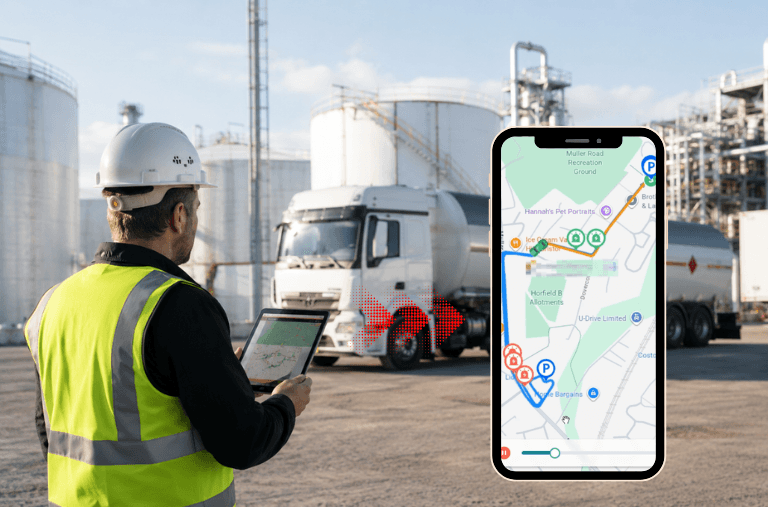
Multi-sensor data monitoring extends location tracking into dynamic environmental oversight by connecting external sensors directly to the central onboard telematics unit. Integrated IoT accessories capture continuous data on fuel tank levels, door opening events, cargo vault security, and cold-chain ambient temperatures. When these data streams feed into central monitoring software, managers receive automated alerts regarding unauthorized fuel siphoning, door openings in unauthorized zones, or temperature excursions in refrigerated trailers, protecting cargo integrity before loss occurs.
| Sensor Type | Core Parameter Monitored | Primary Operational Benefit |
|---|---|---|
| GPS / GNSS Tracker | Geographic coordinates & movement speed | Real-time fleet visibility & route auditing |
| Temperature Sensor | Refrigerated cargo ambient temperature | Cold-chain integrity & spoilage prevention |
| Fuel Level Sensor | Liquid tank volume & fuel burn rate | Theft detection & fuel burn optimization |
| Door Status Sensor | Cargo bay door opening & closure events | Security enforcement & cargo theft prevention |
Video surveillance is crucial for commercial fleet safety because visual evidence transforms subjective accident disputes into clear, factual incident reviews. While traditional telematics records vehicle speed and location, onboard video recording systems capture the true context surrounding sudden braking, near-misses, and road collisions. High-definition video recordings provide additional evidence for reviewing accident circumstances, responding to insurance claims, and identifying areas where driver training may be needed.
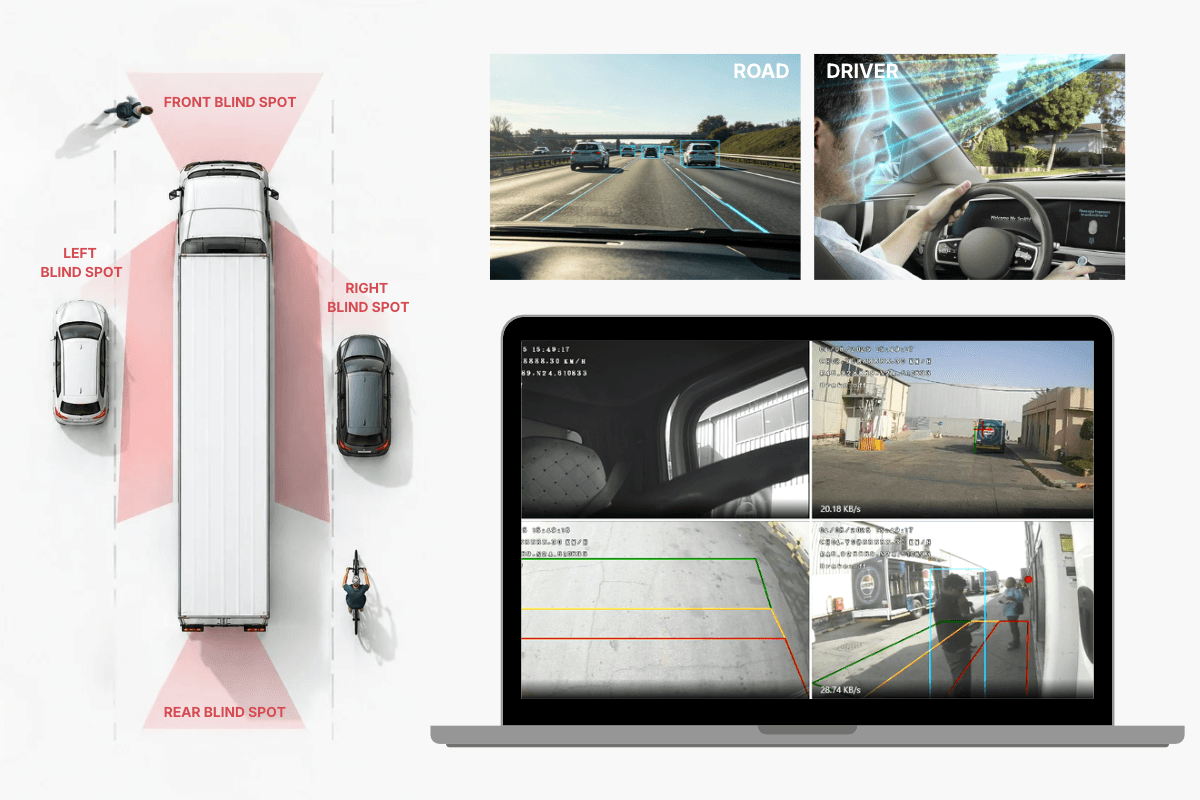
AI driver behavior monitoring utilizes intelligent Driver Monitoring Systems (DMS) embedded in smart dashcams to detect dangerous driving habits in real time. AI-based DMS technologies analyze driver-related visual cues to identify signs of fatigue and distraction. Depending on the device configuration, supported functions may also include detecting phone use, yawning, and smoking. Upon detecting a risk factor, the DMS unit issues instantaneous in-cab audio alerts to redirect the driver's focus, while simultaneously uploading short video clips to the cloud for safety officer review and long-term driver scorecards.
Blind spot detection and collision prevention technologies mitigate the severe physical hazards associated with operating large commercial trucks, engineering vehicles, and passenger buses. Advanced Driver Assistance Systems (ADAS) and Blind Spot Detection (BSD) camera arrays monitor forward lanes and exterior vehicle flanks to calculate pedestrian proximity, lane drift, and forward collision risks. By providing warnings when potential hazards are detected, these AI vision tools give drivers additional time to assess the situation and respond to possible collision risks.
Connected telematics drives operational efficiency by replacing manual administrative tracking with automated, data-driven fleet workflows. Combining real-time sensor streams with centralized management software allows transport companies to control operating costs, minimize unbudgeted vehicle repairs, and streamline daily maintenance logistics. Modern connected platforms turn high-volume telemetry into actionable operational steps that maximize fleet uptime and improve profit margins.
Route optimization and fuel monitoring can help fleet managers identify unnecessary idling, inefficient driving patterns, and avoidable route deviations. By using these records to adjust dispatch plans and driving practices, operators can identify opportunities to improve fuel efficiency. Telematics systems correlate GPS speed profiles, engine idling durations, and harsh acceleration patterns to pinpoint wasteful driving habits across specific routes. Fleet managers leverage these insights to assign optimal transit corridors, enforce zero-idling policies, and prevent unauthorized vehicle use.
Remote maintenance and FOTA configuration streamline ongoing IT administration by eliminating the need to manually physically service hardware across large vehicle fleets. Using FOTA Web and remote configuration tools, engineering teams can update compatible device firmware and adjust supported camera settings without visiting each vehicle. They can also use available diagnostic functions to review device status remotely.
These capabilities reduce the need for routine on-site configuration work. However, physical repairs and hardware replacements may still require depot maintenance.
BSJ Technology provides commercial vehicle fleet operators, system integrators, distributors, and OEMs with robust, end-to-end hardware ecosystems engineered for high-demand industrial deployments. Known globally as BSJ (Boshijie) Technology, the company is a publicly listed enterprise founded in 2009. Featuring massive manufacturing scale with 28 automated SMT lines and an in-house team of over 400 R&D specialists, BSJ has deployed more than 9 million IoT devices across 30+ countries. BSJ develops and manufactures AI video telematics hardware and connected fleet IoT solutions for commercial vehicle operators, system integrators, distributors, and OEM partners.

BSJ develops a versatile commercial hardware portfolio engineered for complex vehicle environments, including logistics trucks, mining machinery, oil and gas tankers, public transit buses, and cold-chain fleets. Core hardware offerings include high-definition AI Dashcams, multi-channel Mobile Digital Video Recorder (MDVR) Systems, robust 4G GPS Trackers, and specialized IoT sensors. By embedding ADAS, DMS, and BSD vision algorithms directly into device firmware, BSJ hardware delivers real-time driver risk alerts, reliable multi-angle video recording, and continuous vehicle telemetry under extreme operational stress.
BSJ empowers telematics platform providers and system integrators by offering software utilities alongside open platform integration protocols. Their software stack includes the BSJ Monitoring System for fleet tracking and video surveillance, the BSJ Configurator for local device setup, and FOTA Web for remote batch firmware maintenance. Recognizing that enterprise clients prefer utilizing their own software backends, BSJ supports third-party platform integration through open APIs and standardized protocols, enabling seamless integration into existing software ecosystems without proprietary lock-in.
Modern commercial vehicle fleet management requires an integrated approach that connects real-time GPS tracking, AI-powered video safety, and remote telemetry management into a single operational framework. Relying on legacy location trackers leaves fleets exposed to unmonitored driver risks, high fuel waste, and unresolved accident liabilities across demanding sectors like logistics, mining, and public transit. Partnering with an established manufacturer like BSJ (Boshijie) Technology delivers the AI dashcams, multi-channel MDVR systems, and flexible integration tools required to achieve complete fleet visibility and driver safety. Equipping fleets with robust telematics hardware today ensures reduced operating costs, safer roads, and long-term business scalability.

BSJ Technology (SZSE: 301608) is a global provider of AI Video Telematics and Connected Fleet IoT solutions. Since 2009, BSJ has developed AI Dashcams, MDVR systems, and GPS tracking solutions for commercial fleets worldwide.