Choose your operating system to start
Refrigerated transport presents a different fleet-management challenge from ordinary cargo delivery. A truck can arrive at the correct destination and still create a serious operational problem if the cargo was exposed to unsuitable conditions during the journey. From our perspective, temperature management therefore needs to continue from loading through delivery, with information available while the vehicle is in transit rather than only after it arrives.
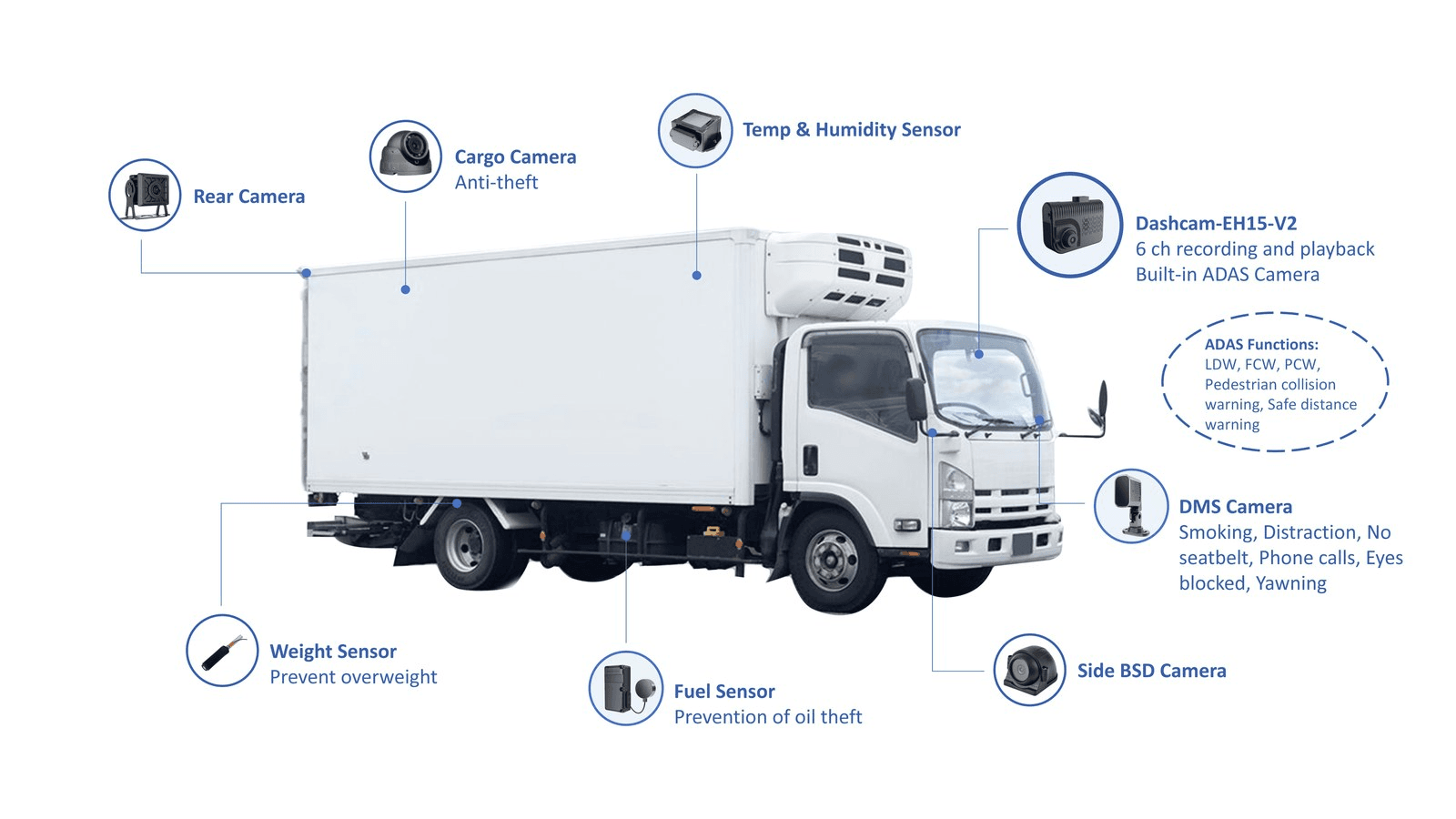
We approach this issue through connected telematics. Instead of treating temperature monitoring as a standalone task, we combine cargo-condition data with vehicle location, driver safety, security, and trip records. This gives fleet operators a broader view of what is happening inside and around refrigerated vehicles and provides useful information when an abnormal event occurs.
Temperature-sensitive goods can be affected by changes in operating conditions, loading procedures, delivery delays, or problems with refrigeration equipment. Manual checks may provide useful snapshots, but they cannot show what happened between two inspection points.
With our cold chain telematics solutions for fleets, temperature and humidity can be monitored throughout a vehicle's journey. Our cold-chain solution supports monitoring across up to four independent temperature zones, with published temperature accuracy of ±0.5°C. We believe this level of visibility is more useful for commercial fleets than relying on a single reading taken before departure or after arrival.
Real-time monitoring also changes how operators can respond. When a temperature deviation is detected, the fleet team can examine the situation while the vehicle is still moving. This creates an opportunity to investigate the cause and determine whether operational action is necessary.
Temperature information becomes more meaningful when it can be connected to the vehicle's location and journey history. A deviation on its own may tell an operator that something changed, but location data can help establish when and where the change occurred.
This is one of the core capabilities of cold chain telematics solutions for fleets. We therefore integrate GPS tracking into our approach to refrigerated transportation. Fleet managers can review cargo conditions alongside vehicle movement and trip information. For example, if a temperature event occurs during a scheduled stop, the operator can examine the timing and location before deciding whether further investigation is required.
This connection can also help identify recurring operational patterns. If similar events repeatedly occur during loading, unloading, or specific sections of a route, managers have more information to examine their processes. The purpose is not to assume that every deviation has the same cause, but to make the available evidence more useful.
Cargo protection and driver safety are often discussed separately, but we see both as parts of the same fleet environment. A refrigerated truck still operates on public roads, and the condition of the driver can directly affect transportation reliability.
Our cold-chain offering includes AI-powered Driver Monitoring System functions designed to detect issues such as fatigue, distraction, and seatbelt violations. Advanced Driver Assistance System capabilities can also provide safety alerts related to driving conditions. These functions add another layer of information to the fleet manager's view without requiring the operator to manage an entirely separate vehicle-safety system.
For B2B fleet operators, this combined approach can be practical. A temperature alarm may require attention from an operations team, while a driver-safety alert may require intervention from fleet management. Having both types of information within a connected telematics environment can make responsibility and response easier to organize.
Keeping cargo at the correct temperature is only part of protecting a refrigerated shipment. Unauthorized access, cargo tampering, and fuel theft can also affect transportation costs and delivery security.
We include cargo-monitoring cameras and fuel anti-theft sensors within our cold-chain solution. These functions can generate additional event information when unusual activity is detected. From our perspective, the value comes from connecting physical cargo protection with the same telematics infrastructure used for tracking and monitoring.
This is particularly relevant for fleets carrying high-value or sensitive products. A security event can be considered alongside the vehicle's location and trip history, helping management establish a clearer record of what happened during transportation.
One of the practical advantages of connected monitoring is the ability to maintain a more complete history of each journey. Our solution supports trip data logging and traceability, allowing operators to review information from completed transportation activities.
We consider this useful for more than internal fleet review. When questions arise about a delivery, operators may need to establish what happened during transit. Temperature records, vehicle locations, and related events can provide supporting information for an investigation.
This does not replace the operating procedures or regulatory requirements that apply to a particular type of cargo. Instead, a digital record can make it easier for businesses to demonstrate how a shipment was monitored and to identify areas where transportation processes may need improvement.
When evaluating cold chain solutions, we focus on how the technology fits the entire fleet workflow. Temperature sensors need to provide useful readings, communication needs to remain reliable, and the resulting data needs to be accessible to the people responsible for transportation operations.
The ability to monitor multiple temperature zones can be relevant when different areas of a refrigerated vehicle have different requirements. GPS tracking adds journey context, while video and driver-monitoring functions address safety and security. Together, these capabilities can provide a more complete picture than temperature monitoring alone.
We also recognize that B2B projects differ considerably. A regional logistics company may have different priorities from a large fleet operator or a telematics platform provider. Hardware selection, deployment scale, software integration, and customization requirements should therefore be considered before a solution is implemented across an entire fleet.
At BSJ Technology, we prioritize AI video telematics, GPS tracking, Fleet IoT, and fleet-management hardware for commercial transportation. Our broader portfolio includes AI dashcams, GPS trackers, and MDVR systems, while our software environment supports device configuration, remote management, and fleet visibility.
Our cold chain solutions focus on refrigerated transportation, and we believe the strongest approach is not to monitor temperature in isolation. The more useful model connects cargo conditions with vehicle location, driver safety, security events, and trip history. That gives fleet managers information they can use both during transportation and when reviewing completed journeys.
Ultimately, successful cold-chain management depends on maintaining control throughout the entire delivery process. We see telematics as a practical way to provide that ongoing visibility. By combining real-time temperature and humidity monitoring with tracking, safety, security, and traceability functions, businesses can build a more structured approach to refrigerated fleet management while keeping the technology aligned with real operational needs.

BSJ Technology (SZSE: 301608) is a global provider of AI Video Telematics and Connected Fleet IoT solutions. Since 2009, BSJ has developed AI Dashcams, MDVR systems, and GPS tracking solutions for commercial fleets worldwide.