Choose your operating system to start
Temperature-sensitive transport requires visibility into both cargo conditions and vehicle movement. In practice, a cold chain fleet management solution can connect environmental readings with GPS, driver events, video, door activity, and trip history so fleet teams know not only that a deviation occurred but also where it happened and what was occurring around the vehicle. That context matters when product quality, customer acceptance, and operational accountability depend on a reliable trip record.
Cold-chain buyers should therefore evaluate the full information path from sensor placement to final reporting. Temperature and humidity measurement, transmission, alert rules, vehicle identity, route status, video evidence, retention, and escalation all need defined responsibilities. A sensor alone can produce data, but a fleet needs a repeatable method for deciding which changes require immediate intervention and which belong in later quality review.
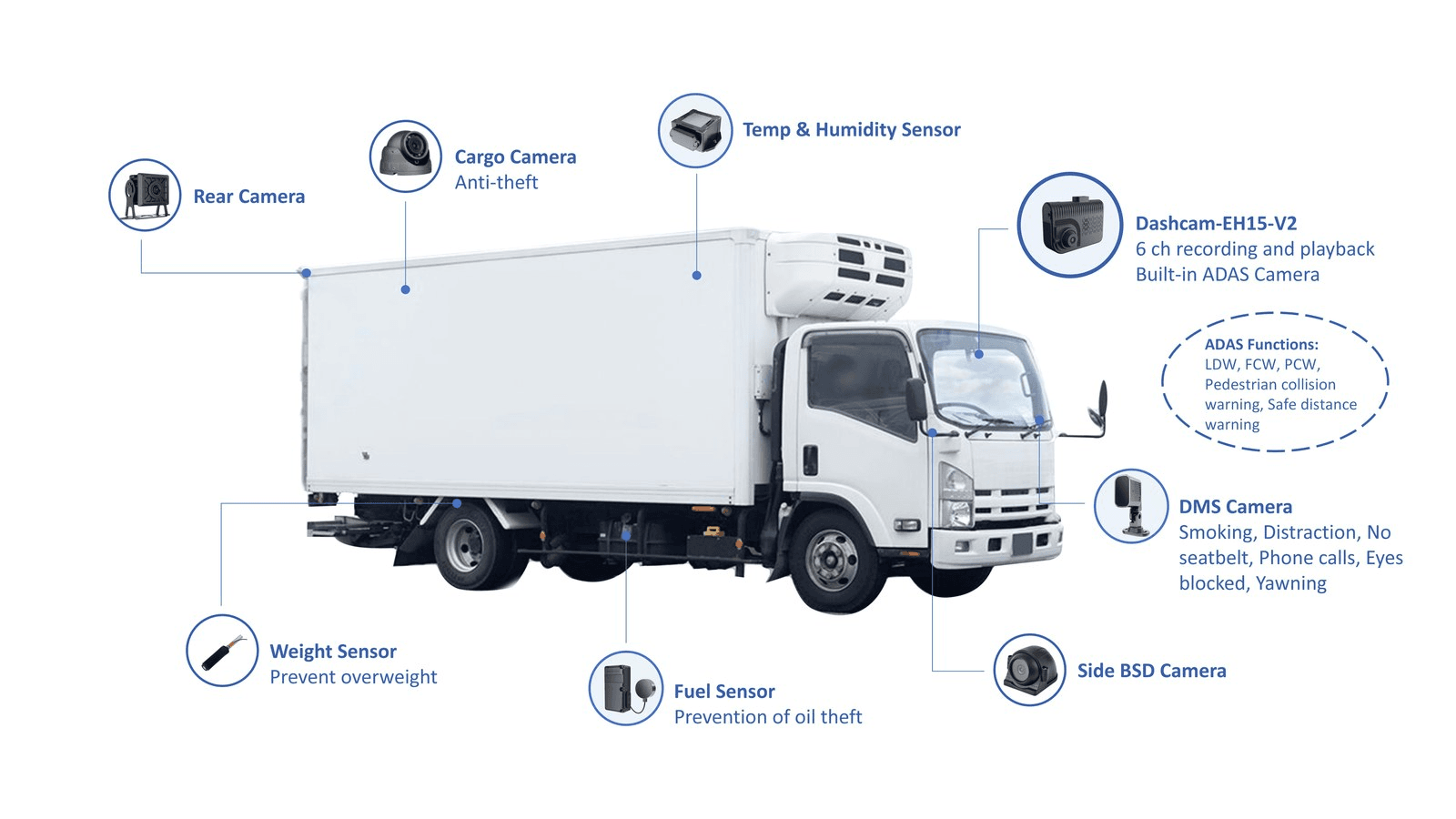
Sensor placement has a direct effect on what the data represents. Refrigerated bodies can contain different airflow patterns, loading arrangements, evaporator positions, and temperature zones. A multi-zone cold-chain solution can support environmental monitoring, so commissioning should document which sensor belongs to which compartment and confirm that the selected positions reflect the cargo environment rather than a convenient mounting point. Calibration and maintenance should be part of the installation record.
A temperature reading can become misleading if a probe drifts, a connector is damaged, or a replacement sensor is installed without updating its identity. Quality teams benefit from knowing the sensor type, location, commissioning result, and service history behind each trip record, especially when an exception later needs to be explained to a customer. GPS provides the timeline around the measurement.
When environmental data is tied to the trip, cold chain telematics solutions for fleets can associate an environmental alarm with vehicle position, route, stop duration, loading activity, or delivery stage. A brief change while doors are open at an approved warehouse may have a different meaning from a sustained deviation during highway travel, even if both cross the same numerical threshold. Power behavior also matters during loading, waiting, and ignition-off periods.
Monitoring should continue for the period required by the operation, and the buyer should verify how the device responds to low voltage or temporary communication loss. The goal is to avoid gaps precisely when the vehicle is stationary and cargo may still need environmental supervision.
Alert design should reflect product risk rather than every small fluctuation. Door opening, defrost cycles, loading delays, and airflow changes can produce temporary variation, so thresholds may need duration or route context before escalation. A useful rule distinguishes a condition that deserves observation from one that requires driver contact, refrigeration service, load inspection, or customer notification.
In refrigerated projects, we at BSJ Technology build our cold-chain solution around temperature and humidity monitoring, GPS tracking, driver-safety functions, cargo protection, and complete trip data. From a cold-chain procurement perspective, the relevant question is how those functions map to the buyer's quality procedures, vehicle layouts, product categories, and escalation responsibilities rather than how many data points the platform can display. Video and external sensors can add evidence when the business case requires it.
Road or cabin footage can explain a safety delay, while cargo-area video, door information, or fuel data may help investigate unauthorized access or abnormal operating events. Each additional source increases installation and data-management requirements, so fleets should add it only when a defined workflow will use the evidence. Device health is another responsibility for cold chain telematics solutions for fleets, not only cargo alarms.
A stuck reading, implausible value, missing device, or communication failure needs its own service workflow because an apparently quiet dashboard can be more dangerous than an explicit exception. Device-health monitoring gives operations and quality teams a way to distinguish normal conditions from missing information.
A complete trip record can combine environmental history, location, stops, alerts, acknowledgements, video references, and the response taken. This creates a stronger basis for delivery acceptance, internal investigation, and continuous improvement than an isolated temperature chart. Retention periods should reflect contractual, quality, and privacy requirements, with access limited to the people who need the information. Exception analysis can reveal recurring operational patterns.
If temperature changes repeatedly at one customer site, the cause may involve unloading time or door management. If deviations begin on particular routes or vehicles, maintenance or refrigeration performance may deserve attention. Linking environmental and route data helps teams prioritize practical corrective actions instead of treating every event as unrelated. Our engineering teams support OEM/ODM and integration requirements when customers need different sensor counts, vehicle interfaces, or third-party platform connections.
Those variations should be validated in a controlled pilot that includes the actual reefer body, network conditions, loading process, and quality team. The result should be a documented configuration that can be reproduced when the fleet expands. Environmental monitoring is credible only when an alert can be traced back to a trusted sensor, a vehicle, a location, and a documented response.
Our cold-chain team at BSJ Technology connects a cold chain fleet management solution with temperature and humidity data, GPS, driver-safety information, cargo evidence, and integration support. Cold chain telematics solutions for fleets should help quality teams distinguish a brief operational fluctuation from an event that threatens the load, while also showing whether a sensor or device has stopped reporting.
We recommend validating the complete chain under the actual reefer body, route, loading process, and network conditions. That creates a reproducible configuration that supports both live intervention and later quality review without turning every reading into an isolated alarm.

BSJ Technology (SZSE: 301608) is a global provider of AI Video Telematics and Connected Fleet IoT solutions. Since 2009, BSJ has developed AI Dashcams, MDVR systems, and GPS tracking solutions for commercial fleets worldwide.