Choose your operating system to start
A refrigerated load can arrive on time and still fail its service requirement. Temperature-sensitive transport depends on maintaining acceptable environmental conditions throughout loading, travel, stops, and delivery, while the vehicle itself must remain safe and visible. For temperature-sensitive transport, cold chain fleet management therefore has to connect sensor readings with route, time, vehicle status, driver events, and a response process that can distinguish a brief operational fluctuation from a genuine cargo risk.
The quality of the final report is determined long before an alarm appears on screen. Sensor selection, placement, calibration, power continuity, mobile communication, timestamp accuracy, and escalation rules all influence whether environmental data can be trusted. Cold-chain operators should design the project as a traceability chain rather than as a standalone temperature monitor, especially when records may later support customer acceptance, quality investigations, or compliance.
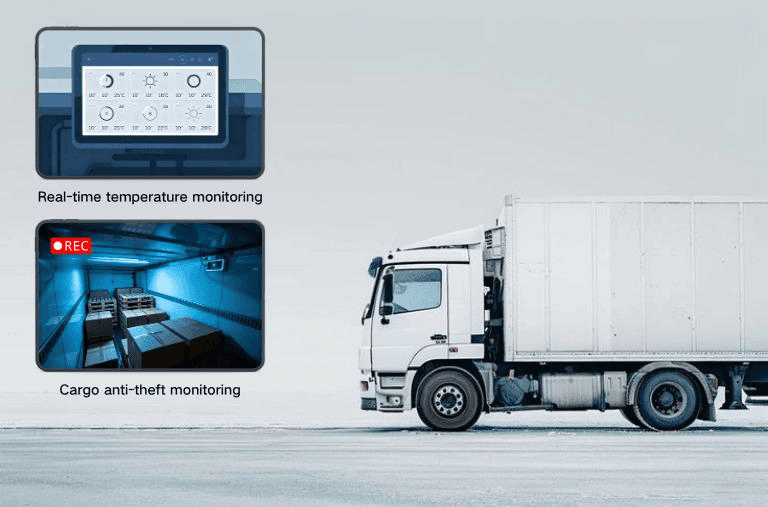
Sensor placement should reflect the cargo environment, not simply the easiest mounting point. Airflow, evaporator location, pallet arrangement, door openings, and multi-zone compartments can create meaningful differences inside one vehicle. A cold chain fleet management solution may therefore use several temperature or humidity sensors, but each sensor needs a documented identity and location so later reports are interpretable. Calibration and commissioning turn sensor output into defensible operational data.
The installation team should verify readings across expected conditions, record sensor serial numbers where appropriate, and define replacement procedures. A drifting or implausible sensor needs a maintenance workflow rather than being allowed to feed incorrect values into customer reports. Periodic checks can be aligned with normal refrigeration or vehicle service intervals. Power continuity deserves specific testing because loading and waiting periods may occur with the ignition off.
The telematics device and environmental sensors need an operating strategy that protects the battery while preserving the monitoring period required by the shipment. Low-voltage behavior, backup arrangements where used, and reconnection after power interruption should be included in acceptance testing rather than assumed from nominal specifications. Alert thresholds must include time as well as temperature.
A brief change during door opening or defrost can have a different business meaning from a sustained excursion on the road. The fleet can define warning and critical levels, delay periods, route-stage rules, and escalation ownership. This reduces unnecessary notifications while ensuring that conditions with a realistic product-quality impact receive attention quickly.
GPS adds the where and when to an environmental alarm. A recurring deviation at the same delivery site can indicate prolonged door opening, while an excursion beginning during highway travel may point toward refrigeration, power, or airflow problems. Linking the reading to route history, stops, ignition status, and geofences allows quality and operations teams to investigate causes instead of reviewing an isolated graph.
In our refrigerated projects at BSJ Technology, we combine temperature and humidity monitoring with GPS, AI driver-safety functions, cargo-protection options, and trip data. Our broader hardware range includes trackers, AI dashcams, MDVR systems, and sensor interfaces. Customers can use those components to build different vehicle packages while maintaining an integrated data path and, where needed, connections to third-party fleet platforms.
Video can provide useful context when a shipment exception involves access, delay, or road events. Cargo-area footage may help investigate a door opening or handling dispute, while road-facing and driver-facing video can explain a safety incident that interrupted the trip. The fleet should still define why each camera is present, because every additional video channel creates installation, bandwidth, storage, privacy, and support requirements.
Driver safety is part of cold-chain continuity even though it is not an environmental measurement. Fatigue, distraction, harsh maneuvers, or collisions can delay the vehicle and create secondary cargo risk. A well-designed cold chain fleet management process therefore allows safety alerts to be reviewed alongside sensor and route data. The same trip timeline can show what happened to the driver, vehicle, and load around the exception.
Trip records should be designed for the people who will use them after delivery. Quality teams may need environmental history and alarm acknowledgements; operations may compare route and dwell time; customers may require evidence of conditions; and maintenance teams need sensor-health information. A common report structure reduces manual reconciliation and makes it easier to distinguish a cargo event from an instrumentation or communication problem.
Access and retention rules should reflect contractual and regulatory needs without preserving unnecessary data indefinitely. Temperature logs may need longer retention than routine video, while critical clips can be stored around selected events. User roles should control who can view, export, or delete sensitive records. These governance choices belong in the project specification because they affect platform configuration and storage cost.
We support customization, OEM/ODM cooperation, global technical assistance, and open integration for projects that use different sensor counts, vehicle interfaces, or software environments. Those capabilities are particularly relevant to cold-chain solution providers serving several customer types. During a pilot, they should be tested through calibration records, data continuity, alert delivery, remote configuration, and the process for diagnosing a failed sensor or device.
Cold-chain decisions depend on confidence in both the reading and the response that follows it. For refrigerated-fleet projects, our team at BSJ Technology links environmental sensing with GPS, driver-safety data, cargo evidence, and trip records so an exception can be traced to a specific vehicle and journey. Cold chain fleet management works more reliably when sensor placement, alarm duration, calibration, access rules, and escalation ownership are established before commercial rollout.
A cold chain fleet management solution can then support quality teams without asking them to reconstruct events from unrelated systems. The result is a documented transport record that helps operations intervene during a trip and gives customers or internal reviewers a clearer basis for evaluating what happened afterward.

BSJ Technology (SZSE: 301608) is a global provider of AI Video Telematics and Connected Fleet IoT solutions. Since 2009, BSJ has developed AI Dashcams, MDVR systems, and GPS tracking solutions for commercial fleets worldwide.