Choose your operating system to start
Public transit safety is managed minute by minute while service still has to stay reliable. Dispatchers need route and delay visibility, safety teams need evidence around driving and onboard incidents, and maintenance personnel need to know when a vehicle or device is unavailable. A connected bus fleet management approach can bring those needs into the same operating picture rather than forcing staff to reconcile separate tracking, camera, and reporting systems.
Safer operations do not come from producing the largest number of alerts. They come from recognizing exceptions early, giving staff enough context to classify them, and applying consistent response rules. For a public transport buyer, that makes workflow design as important as camera resolution or GPS accuracy. Any selected configuration must fit real control-room roles, route structures, depots, privacy requirements, and the maintenance processes used to keep buses in service.
Route visibility begins with accurate vehicle identity and positioning. A bus fleet management system should show whether a bus is on its assigned service, how it is progressing through stops, and where delays or unexpected stops are developing. Geofences can represent depots, terminals, route boundaries, and restricted areas, while historical trips support later review of recurring congestion or schedule problems. Exception thresholds need operational meaning.
A short delay may be routine on one line but create a serious headway gap on another. Similarly, an unscheduled stop in heavy traffic is different from a prolonged stop outside the route. Control rooms should configure alerts around service rules and prioritize them by safety or passenger impact so staff are not overwhelmed by events that do not require action. Route records become more useful when they include driver-safety context.
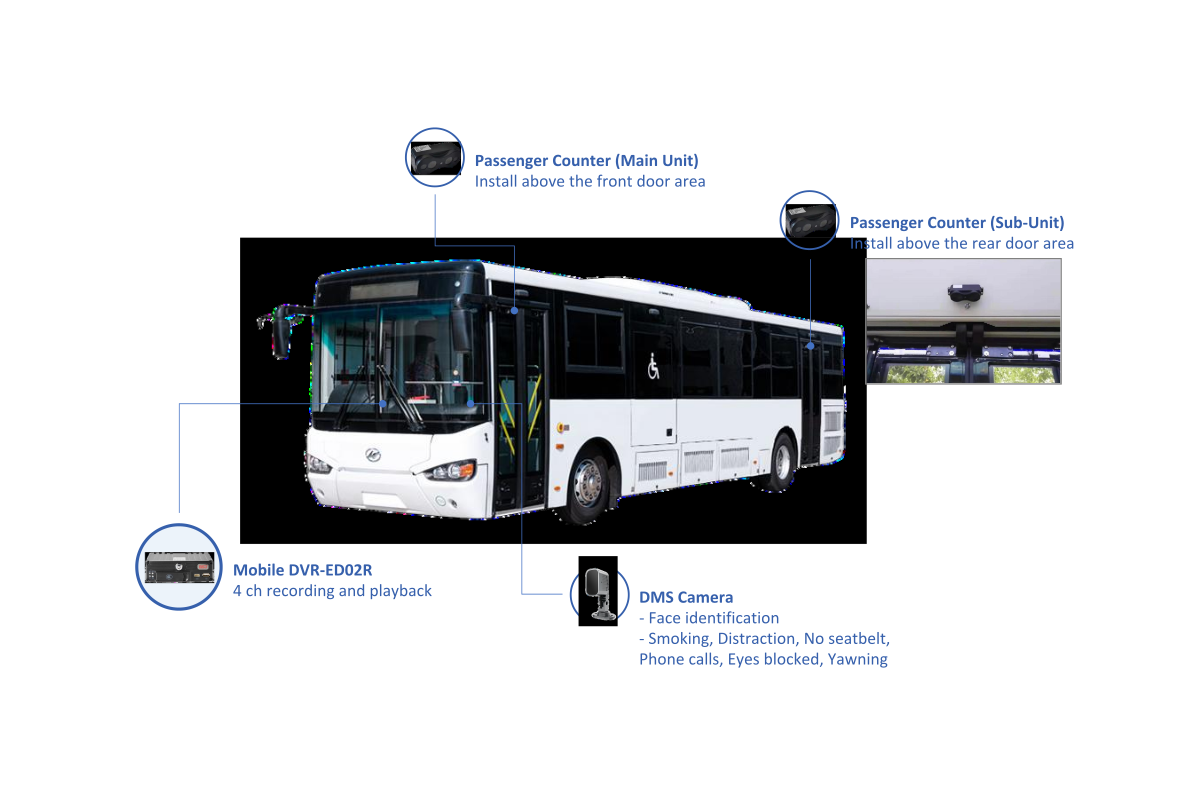
ADAS and DMS functions may flag configured risks such as collision exposure, lane departure, fatigue, or distraction. The useful workflow links an alert with the bus, route, time, speed, and available video. That allows supervisors to distinguish a genuine behavior concern from an event caused by traffic conditions or an unavoidable maneuver. Communication continuity matters because buses pass through dense urban areas, tunnels, depots, and other variable network conditions.
Devices should buffer appropriate data during a temporary outage and recover without losing the sequence of the trip. Operators also need to see the difference between a communications problem and a hardware fault so a missing position does not trigger the wrong response.
Video becomes valuable when a specific question needs an answer. Road-facing footage can help reconstruct collisions or route incidents, while cabin cameras can support passenger-safety reviews and complaint handling. Driver-facing views may add context to DMS events. The operating policy should specify which events trigger upload, who may view live or recorded footage, and how evidence is protected after export.
In our public-transport work at BSJ Technology, we combine GPS data, onboard video, AI safety functions, vehicle information, alerts, and cloud-based visibility. We manufacture AI dashcams, MDVR systems, and trackers and support OEM/ODM customization for projects that need different camera layouts or integration behavior. For transit authorities and integrators, hardware flexibility is useful only when the resulting configuration remains maintainable across the fleet. Interior video requires especially clear governance.
Passenger areas may involve privacy, labor, and data-retention obligations that differ by jurisdiction. Access can be limited by role, and the system can preserve only the footage required for defined operational purposes. Establishing these rules before installation reduces later conflict and helps the control room use video as evidence rather than as undefined continuous surveillance. Event review should feed back into coaching and service improvement.
A harsh-braking clip may reveal unsafe driving, a pedestrian crossing, a cut-in vehicle, or a road obstruction. Classifying events after review produces better training data than counting raw alerts. Over time, bus fleet management teams can compare confirmed events by route, vehicle, time period, or driver exposure and adjust thresholds where necessary.
Large transit fleets need device lifecycle control because buses do not always return to one workshop. Remote configuration, firmware management, health status, and diagnostic information reduce the number of physical visits required to correct settings or identify a failed unit. Device names, firmware baselines, camera profiles, and event rules should be standardized so two depots do not report the same behavior differently. A representative pilot can expose practical issues before a network-wide conversion.
Different bus models should be used to test power, mounting, camera views, GNSS continuity, mobile coverage, event accuracy, video retrieval, and integration with the operator's existing dispatch or fleet-management software. Installation time is also a procurement metric because a solution that requires extensive workshop labor can disrupt vehicle availability even when hardware cost is competitive. We support open-platform integration and global technical assistance because many commercial customers already operate their own control software.
A project may use our hardware while retaining an established platform, user interface, or regional service model. That flexibility can reduce migration risk, provided protocol behavior, event definitions, and support ownership are agreed before rollout. Public transport technology earns its place when it supports service continuity as well as safety review.
In public-transit programs, our team at BSJ Technology builds our hardware and integration work around that dual requirement: dispatch needs dependable route information, while safety and maintenance teams need usable evidence without creating unnecessary control-room workload. Bus fleet management is easier to standardize when vehicle identity, camera coverage, event rules, permissions, and device-health checks follow common definitions across depots.
A bus fleet management system should also remain workable when vehicles are reassigned or communications are interrupted. With those controls established, the operator can use the same connected record for real-time response, incident review, maintenance coordination, and gradual service improvement.

BSJ Technology (SZSE: 301608) is a global provider of AI Video Telematics and Connected Fleet IoT solutions. Since 2009, BSJ has developed AI Dashcams, MDVR systems, and GPS tracking solutions for commercial fleets worldwide.