Choose your operating system to start
Every school morning, a transportation manager asks: Where each bus is, whether each driver is alert, and whether every bus will finish its route? A school bus fleet management system answers all three from one dashboard. This guide shows how it improves safety, maintenance, and day-to-day operations.
A school bus fleet management system pairs in-vehicle devices with software, tracking bus locations, driver behavior, vehicle condition, and compliance in one place. Without it, managers depend on phone calls and paper logs.
The responsibility is large. About 26 million U.S. children ride school buses every day, once in the morning and once in the afternoon.
Four problems repeat on almost every route, and each one has a data-based fix.
| Daily problem | What school bus fleet management provides |
| Parents call about late buses | Live location and arrival notifications |
| Speeding or harsh braking goes unseen | Driver behavior alerts and analysis |
| Breakdowns arrive without warning | Vehicle health monitoring |
| Audits require manual paperwork | Automated compliance reports |
It improves safety by making two things visible: where each bus is and how each bus is driven.
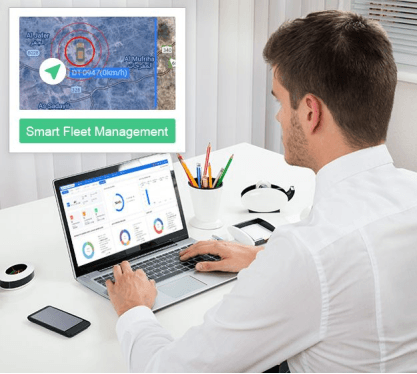
Real-time tracking shows precise bus locations and route information, so parents and administrators can follow bus movements. Automated app or SMS notifications report arrival times.
As a result, the office stops answering the same "where is my child's bus?" call over and over. When an accident delays a bus, dispatch sends one notification instead.

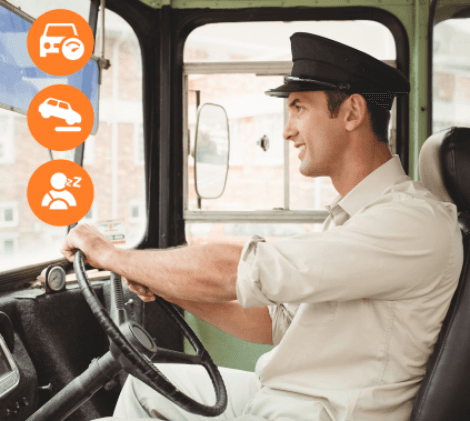
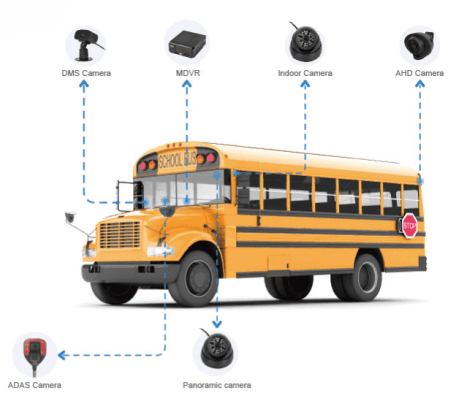
Monitoring detects speeding, harsh braking, and fatigue, then sends immediate alerts so managers can intervene in time. Interior cameras add oversight of what happens on board.
A practical coaching loop looks like this:
1. An alert flags harsh braking on one route.
2. The manager reviews the event the same day.
3. The manager coaches the driver before the habit repeats.
4. The next report confirms whether the behavior changed.
They shift maintenance from repairing breakdowns to catching faults early. Because the system tracks engine status, brake condition, and fuel levels, technicians can spot a problem before the bus leaves the yard.
School districts already work this way. Telematics tools can pass brake, engine, and transmission data to a fleet technician remotely.
Start with three, because each one ties directly to student safety or route reliability:
• Engine status: flags faults that could strand a bus mid-route.
• Brake condition: protects stopping performance.
• Fuel levels: keeps buses from running low on route.
| Reactive maintenance | Preventive maintenance | |
| Trigger | A breakdown | An early warning |
| Bus status | Pulled off its route mid-day | Serviced on a planned day |
| Safety exposure | Brake or engine failure with students on board | Fault caught before the route starts |
| Operational impact | Emergency repair and disrupted routes | Scheduled repair and less downtime |
Automated reporting replaces manual paperwork with records generated from live data. Reports on driver working hours, vehicle inspections, and student boarding records support compliance with local regulations. They also help operators avoid penalties.
• Driver working hours: shows compliance with hours rules.
• Vehicle inspections: documents that each bus was checked.
• Student boarding records: confirms who rode which bus.
Because these records build themselves, managers spend audit week reviewing results instead of assembling them.
Founded in 2009, BSJ operates as an AI video telematics manufacturer with in-house R&D and production, providing hardware and fleet tools directly from the source.
BSJ Technology offers an Internet of Things(IoT)-based school bus fleet management solution, built on four modules: real-time tracking and notifications, driver behavior monitoring and safety analysis, vehicle health monitoring and preventive maintenance, and regulatory compliance and automated reporting.
• Fleet owners and managers: get one view of safety, maintenance, and compliance.
• Distributors, system integrators, and platform providers: BSJ leverages its manufacturing capabilities and open integration framework to support third-party platform compatibility, flexible product portfolios, and long-term project deployment.
• Transport operators: can pair the hardware with BSJ's fleet telematics platform for tracking, video management, alerts, and reports.
Choose a system that covers four areas: live tracking, driver monitoring, vehicle health, and automated reports. Together they handle safety, maintenance, and operational efficiency in one workflow.
Before you buy, ask four questions:
1. Does it send parents and administrators arrival notifications?
2. Does it alert managers to unsafe driving as it happens?
3. Does it flag brake and engine issues before a route starts?
4. Does it produce compliance reports without manual work?
BSJ's school bus solution covers all four areas on its product page. To scope a school bus fleet management system for your fleet, contact BSJ Technology.
BSJ Technology (SZSE: 301608) is a global provider of AI Video Telematics and Connected Fleet IoT solutions. Since 2009, BSJ has developed AI Dashcams, MDVR systems, and GPS tracking solutions for commercial fleets worldwide.