Choose your operating system to start
School bus routes run on fixed schedules with children on board. GPS (Global Positioning System) tracking shows where a bus is, but it cannot explain why a bus is late or whether its onboard devices still report. This guide shows how GPS, video, and fleet software fill those gaps.
GPS alone cannot run a school fleet, because location is only one of the facts a dispatcher needs. A map icon indicates location and speed, but provides no insight into stop-level incidents or offline device status.
The stakes are high. The American School Bus Council, cited by School Transportation News, reports that about 53 percent of K-12 students in the United States ride yellow school buses. School Bus Fleet, summarizing a 2017 National Highway Traffic Safety Administration (NHTSA) report, adds that more students are killed outside the bus by the bus itself than by other vehicles.
Operators miss context. A late bus could mean traffic, a long loading stop, or a disconnected tracker. Without video and device status, dispatchers can only guess.
| Question | GPS only | GPS + video + fleet software |
| Where is the bus? | Yes | Yes |
| What happened at a stop or incident? | No | Event playback |
| Is the onboard device working? | Unclear | Device management |
| Who needs to know? | Phone calls | Alerts and reports |
A GPS fleet telematics platform collects vehicle data, sends it to the cloud, and presents it so staff can act. BSJ describes this flow as Device → Cloud → Data → Management.
1. Device: a tracker or camera captures position and video.
2. Cloud: the data is transmitted and stored.
3. Data: the platform organizes it into locations, events, and device status.
4. Management: staff review the results and decide what to do.
Fleet management software is the layer people use every day. Hardware collects the data, but dispatchers and managers work inside the software. They watch routes, review alerts, and pull reports.
The BSJ fleet telematics platform combines three tools: the Monitoring System, the Configurator, and the FOTA Web Platform. BSJ Technology was founded in 2009 and is listed on the Shenzhen Stock Exchange (stock code 301608). It makes AI dashcams, MDVR (mobile digital video recorder) systems, and GPS trackers. As an AI video telematics manufacturer, BSJ provides these software tools—including the monitoring system, configurator, and FOTA platform—to support and configure its hardware, while also enabling integration with third-party fleet management systems.
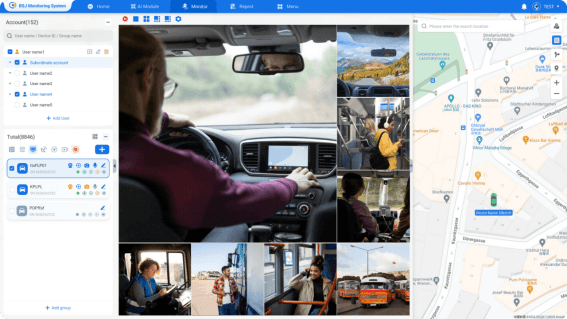
The BSJ Monitoring System covers live video monitoring, GPS tracking, event playback, and fleet status. BSJ also lists alerts, reports, and device management. It is designed to connect BSJ hardware with third-party telematics and fleet management platforms.
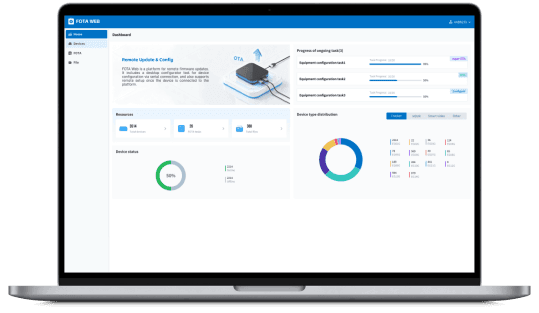
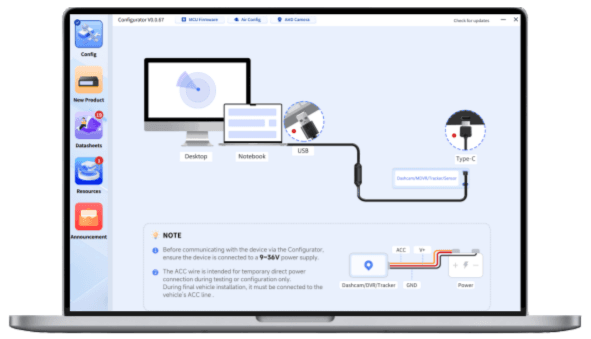
They keep devices set up and up to date. The Configurator configures and manages compatible BSJ devices, and it is available for Windows and macOS. The FOTA (firmware over-the-air) Web Platform handles remote firmware updates, remote maintenance, and large-scale deployment.
| Tool | Role in the workflow |
| Monitoring System | Daily tracking, video, alerts, reports |
| Configurator | Setting up and managing devices |
| FOTA Web Platform | Remote updates and maintenance |
They work as a chain: setup, daily monitoring, incident review, and remote maintenance. The scenario below is hypothetical, not a customer case. It shows how the tools would connect.
1. Before term starts: an installer uses the Configurator to set up each device.
2. Each morning: a dispatcher watches GPS positions and fleet status in the Monitoring System.
3. After a reported incident: a manager uses event playback to see what happened.
4. During the school year: the fleet team pushes a firmware update through FOTA instead of sending technicians to every depot.
A GPS-only setup stops at step 2. Steps 3 and 4 then depend on phone calls, driver recollections, and physical visits. In a connected setup, every step happens within the same software environment.
Start with two questions: does the platform integrate with existing systems, and can you manage devices at scale? Both determine whether the platform fits your customers' fleets.
• Integration: Can the hardware connect to the third-party platforms your customers already use? BSJ states that its open integration supports flexible deployment across fleet ecosystems.
• Setup: Is there a tool to configure many devices consistently?
• Maintenance: Can you update firmware remotely?
• Visibility: Does one system show location, video, and device status together?
For distributors and system integrators, these capabilities directly impact operational efficiency and deployment costs. A hardware and platform ecosystem supporting remote configuration and FOTA helps partners scale deployments without recurring on-site service calls.
Treat GPS, video, and software as one connected system rather than three separate tools. GPS shows where a bus is, video shows what happened, and fleet management software lets your team act on both.
Compare the BSJ fleet telematics platform against the checklist above. Then list your own gaps:
• Unexplained late buses
• Slow incident review
• Manual device maintenance
Choose the tools that close those gaps.

BSJ Technology (SZSE: 301608) is a global provider of AI Video Telematics and Connected Fleet IoT solutions. Since 2009, BSJ has developed AI Dashcams, MDVR systems, and GPS tracking solutions for commercial fleets worldwide.