Choose your operating system to start
An AI video telematics deployment becomes difficult to scale when hardware, video, alarms, configuration, and firmware are managed as separate projects. A fleet telematics platform should connect those layers so a fleet can move from a vehicle event to the correct data, clip, response, and device status without rebuilding the context manually. The architecture matters as much as the individual tracker, dashcam, or recorder.
For commercial operators and solution providers, fleet management software also needs to support the people who run the system every day. Dispatch, safety, maintenance, IT, and technical support may use different parts of the same record. Clear device identities, permissions, history, and remote administration help those teams work from a consistent source rather than maintain parallel spreadsheets and local configuration files.
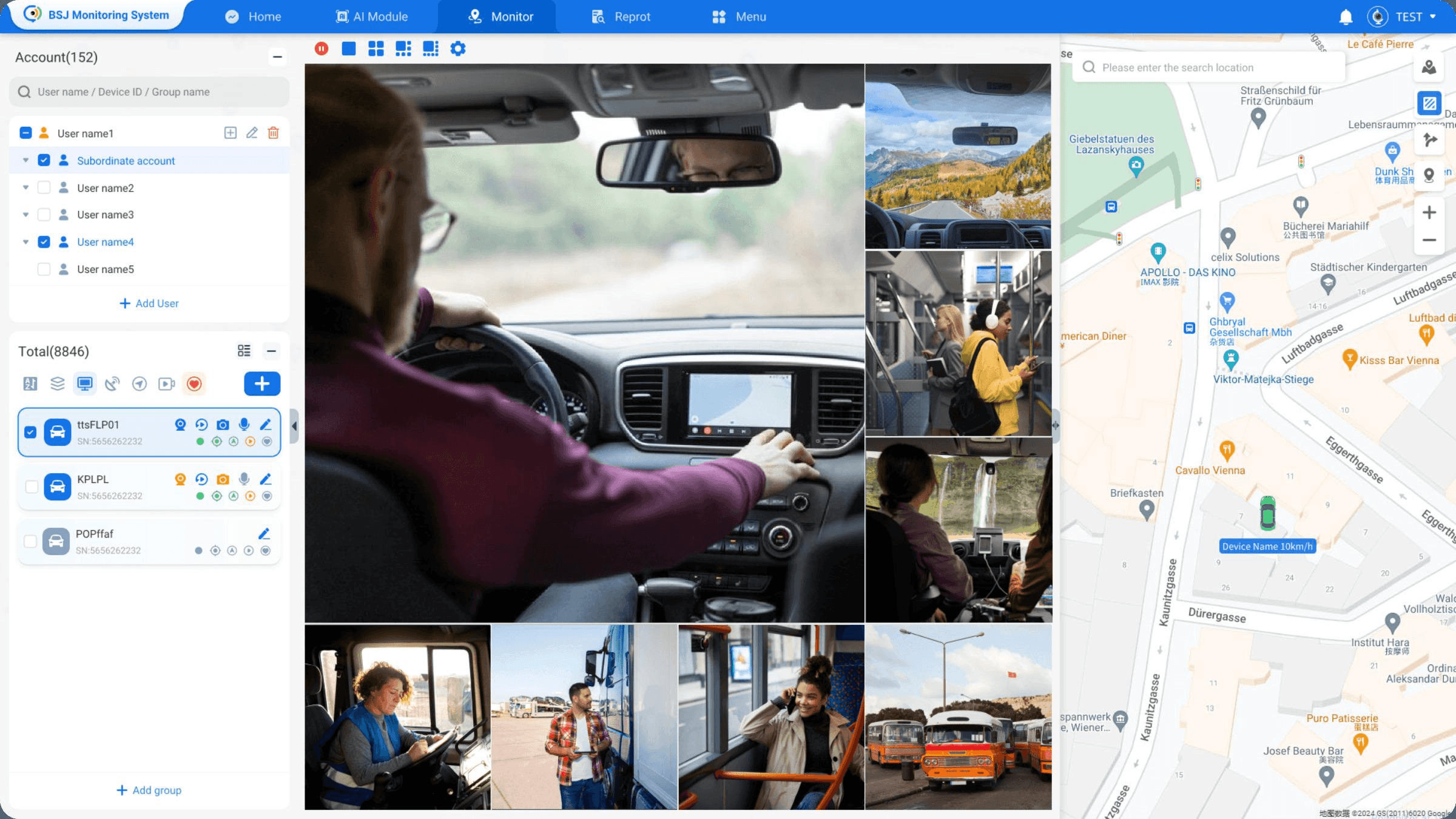
Onboard hardware is where the information chain begins. GPS trackers provide movement and status, AI dashcams add road and driver context, and MDVR systems can collect several camera views and additional inputs. A platform should preserve vehicle identity and timestamps across those sources so a speeding alert, route deviation, driver event, and associated video can be reviewed as one operational sequence. Our software environment includes the Monitoring System, BSJ Configurator, and FOTA Web Platform.
The Monitoring System brings tracking, video access, playback, and data visibility into one cloud interface. Buyers can evaluate whether those functions match their user roles, alert process, historical review needs, and the scale of the fleet they expect to manage. Data quality needs explicit acceptance criteria. Missing positions, incorrect vehicle associations, delayed alarms, time-zone errors, unavailable clips, or inconsistent sensor names can undermine the entire workflow even when each device operates independently.
Pilot testing should therefore follow data from the vehicle through connectivity and server processing to the final user screen, including recovery after temporary network interruptions. Retention and access policies should be separated by data type. A fleet may keep location history for one period, safety events for another, and high-volume video for a shorter interval.
User roles may also differ between dispatch, safety, maintenance, and external customers. Retention rules belong in the architecture before scale because later changes can affect storage cost, privacy controls, and incident-response procedures. Clear role boundaries also reduce the risk that software access expands simply because more devices are connected.
Device configuration is part of fleet operations, not a one-time installation task. Cellular settings, AI thresholds, camera parameters, reporting intervals, and accessory behavior may need adjustment after vehicles enter service. We use BSJ Configurator for device and AI setting management, allowing deployment teams to standardize configurations instead of depending on undocumented local changes. Our remote-management model at BSJ Technology also uses FOTA Web for firmware updates, parameter management, and deployment control.
A fleet customer should test how devices are grouped, how update success is reported, who has permission to push changes, and what happens if a vehicle loses connectivity during an update. Governance around remote change is necessary when thousands of devices share the same production environment. Device health should be visible enough to prevent silent monitoring gaps.
Silent device failures can create incomplete operational records when a camera stops recording, a tracker remains offline, or a unit misses an update. Remote diagnostics can reduce workshop visits, but the support workflow still needs ownership, escalation thresholds, spare-device processes, and a method for distinguishing network problems from hardware or installation faults. Lifecycle data also gives managers a basis for planning.
Firmware versions, configuration history, communication status, and maintenance actions can show where a fleet is becoming inconsistent. A controlled fleet telematics platform makes it easier to identify those differences before they affect reporting or AI behavior, particularly when devices have been installed over several years or through different regional contractors.
Open integration matters because many enterprise customers already use a telematics, dispatch, ERP, TMS, or customer-facing platform. We support third-party environments such as Wialon, RedGPS, Uffizio, Pilot, GpsGate, and PointMatrix. An integration project should validate the exact messages, commands, event mappings, and authentication model needed by the customer's production workflow rather than assume compatibility from a logo list alone.
A flexible fleet management software strategy can also separate hardware lifecycle management from the user interface presented to end customers. Distributors may want our devices and remote tools while retaining their own application, commercial model, and regional services. Stable protocols and technical documentation allow those layers to coexist and can reduce the cost of replacing hardware without replacing the entire business system.
We support this architecture with in-house hardware engineering, software resources, customization, OEM/ODM options, quality control, certifications, and support from our global technical team. A customer's proof-of-concept can convert those capabilities into evidence by testing integration response, configuration changes, firmware handling, device replacement, and support communication under realistic operating conditions. Hardware and software remain easier to operate when their responsibilities are deliberately separated.
In our connected-platform work at BSJ Technology, we use the fleet telematics platform for vehicle data, video, alerts, device status, configuration, and firmware control while allowing customers to keep the fleet management software that already supports their business processes. That architecture depends on stable identifiers, permissions, protocol behavior, and version governance between the two layers.
During the pilot, representative events should be traced end to end so the customer can see where each action occurs and who owns it. Once those boundaries are proven, the organization can expand video telematics without forcing dispatch, maintenance, or customer-service teams to abandon workflows that already work.

BSJ Technology (SZSE: 301608) is a global provider of AI Video Telematics and Connected Fleet IoT solutions. Since 2009, BSJ has developed AI Dashcams, MDVR systems, and GPS tracking solutions for commercial fleets worldwide.