Choose your operating system to start
Commercial vehicle safety increasingly depends on technology that can identify risks before they become incidents. Trucks, buses, taxis, and other fleet vehicles operate for long hours in changing traffic conditions, making driver attention and forward visibility important parts of daily operations. A connected dashcam can add another layer of monitoring by combining camera data with intelligent safety algorithms.
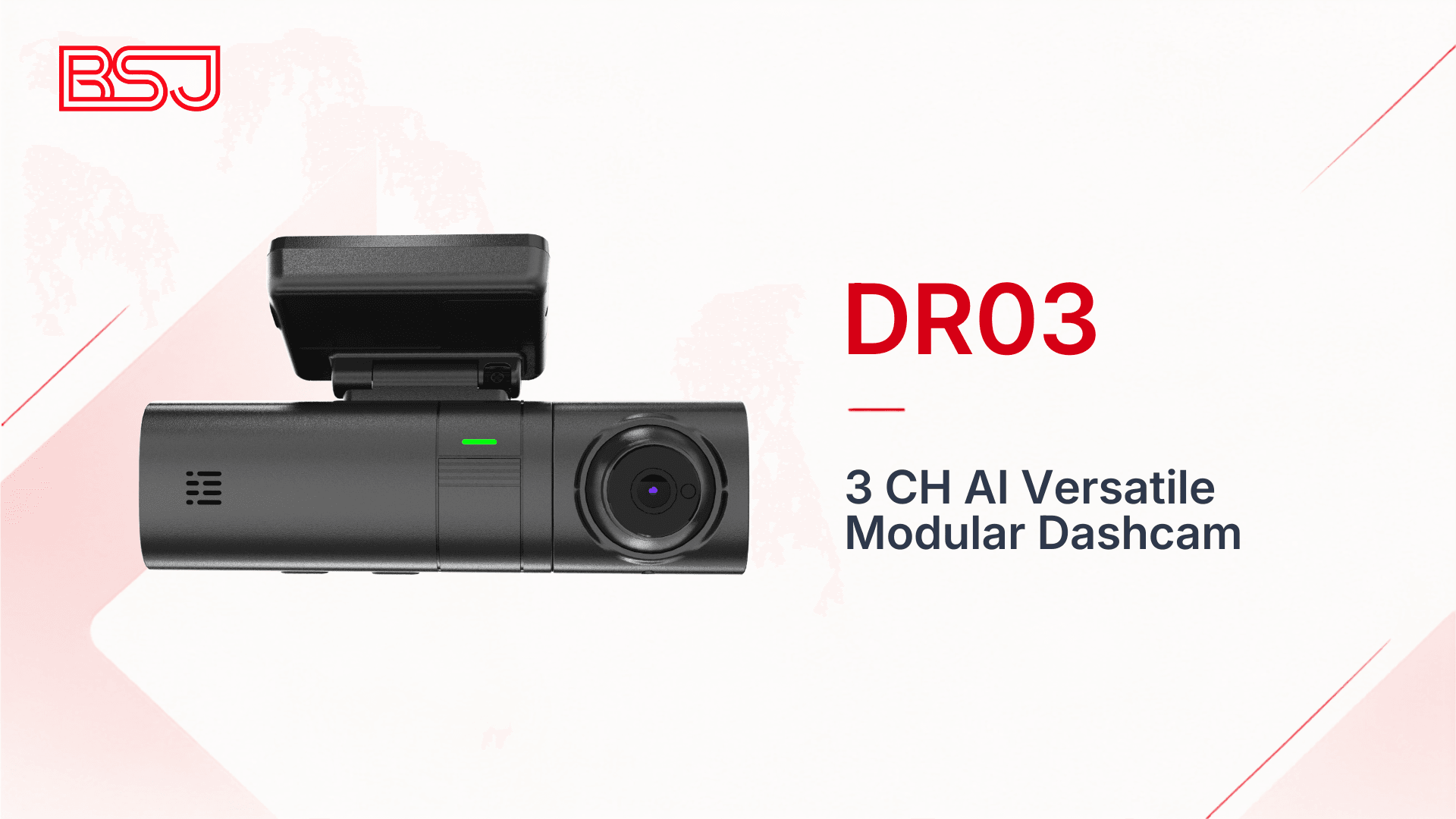
We develop AI video telematics hardware for commercial fleets, and the DR03 is designed specifically as a three-channel AI dashcam with ADAS and DMS capabilities. It combines artificial intelligence processing, high-definition video recording, connectivity, positioning, and remote management in one platform.
Advanced Driver Assistance Systems focus on information from the road environment. Instead of relying only on a driver to recognize every developing risk, ADAS can analyze camera input and generate alerts for defined situations.
On the DR03, ADAS functions are designed to detect collision risks, lane departures, and unsafe following distances. These functions provide drivers with additional awareness of conditions ahead and can support fleet safety programs by making certain risky situations more visible.
An ADAS dashcam is therefore different from a conventional recording camera. The camera still preserves video, but the system also interprets selected road conditions and can respond with safety alerts. This combination can be particularly useful for commercial vehicles that spend extended periods on highways or in busy urban traffic.
Road conditions are only one side of vehicle safety. Driver condition can also affect how quickly a person reacts to an unexpected situation.
The DR03 integrates Driver Monitoring System algorithms alongside ADAS. Its DMS functions can detect driver fatigue and distraction, allowing the vehicle to be monitored from both the road-facing and driver-facing perspectives.
This dual approach is important because a forward-facing camera cannot determine whether a driver is becoming less attentive. Conversely, monitoring the driver's condition without understanding the road environment leaves another part of the safety picture unaddressed.
Different commercial vehicles have different monitoring requirements. Some operators may need only forward-road and cabin views, while others may benefit from an additional external camera.
The DR03 supports up to three camera channels, with configurations covering the forward road view, in-cabin monitoring, and an optional external camera. It provides high-definition video recording and uses H.264 encoding for efficient video processing and storage.
For fleets evaluating a DMS dashcam, this multi-channel design means driver monitoring does not have to be treated as a separate recording system. The cabin view can work alongside forward-facing and optional external coverage within the same dashcam platform.
The DR03, our DMS dashcam, is equipped with a 1.0 TOPS AI NPU and runs on a Linux operating system. The dedicated AI processing capability allows ADAS and DMS algorithms to operate as part of the onboard dashcam architecture.
This is relevant for commercial fleets because safety events need to be identified at the source. The system can process camera information and generate relevant event information without turning every recorded frame into a manual review task.
AI does not remove the need for driver judgment. Instead, it adds another mechanism for recognizing defined conditions and bringing potentially important events to attention.
An alert tells a fleet operator that an event was detected, but recorded footage can provide additional context.
The DR03's multi-channel recording capability preserves visual information covering the available camera views. This can support incident analysis when a fleet team needs to understand what happened before, during, or after a reported event. The official product page describes the three-channel system as suitable for daily operations and incident analysis.
For commercial operators, this creates a useful distinction between prevention and investigation. ADAS and DMS can identify selected safety risks during operation, while recorded video can provide evidence for later review.
A dashcam becomes more useful when it can communicate with the wider fleet environment.
The DR03 integrates 4G LTE CAT.4 connectivity and supports multi-constellation GNSS, including GPS, Galileo, BeiDou, and GLONASS. These features provide the communication and positioning foundation required for connected video telematics.
The combination allows safety events to be considered alongside vehicle location and other fleet information. For example, an event detected by the camera can be associated with where the vehicle was operating, giving fleet personnel additional context for review.
Deploying cameras across a large fleet creates an ongoing equipment-management requirement. Devices may need configuration changes or software updates after installation, especially when fleet policies or operating requirements change.
The DR03 supports remote configuration and FOTA updates and is designed to integrate with fleet management systems. Its wide 9–90V input range also allows the device to adapt to logistics fleets, commercial vehicles, and public transportation applications.
These capabilities can reduce dependence on physical access to individual vehicles and make the dashcam easier to manage as the deployment grows.
When selecting AI video equipment, fleet managers should look beyond camera resolution and consider the complete safety architecture.
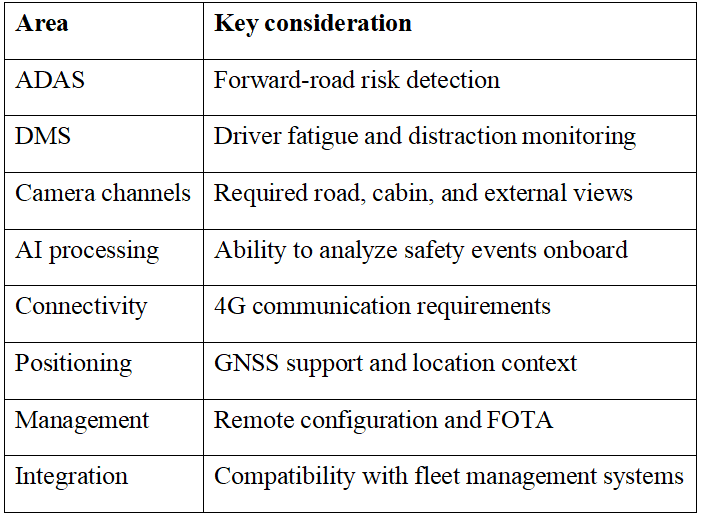
The appropriate configuration depends on the vehicle type, operating environment, and safety objectives rather than on one specification alone.
At BSJ Technology, we develop AI dashcams and video telematics technologies for commercial fleets, combining road monitoring, driver monitoring, multi-channel recording, connectivity, and remote management.
The DR03 provides a practical example of this approach. Its 1.0 TOPS AI NPU, Linux OS, three-channel video capability, ADAS and DMS algorithms, 4G LTE CAT.4 connectivity, multi-constellation GNSS, and 9–90V input range bring multiple fleet-safety functions into one connected device.
For commercial vehicle operators, an intelligent dashcam should therefore be evaluated not simply as a camera, but as part of a wider safety system. The combination of road-risk detection, driver monitoring, visual evidence, positioning, connectivity, and remote device management can give fleet teams more practical information for both preventive safety management and incident review.

BSJ Technology (SZSE: 301608) is a global provider of AI Video Telematics and Connected Fleet IoT solutions. Since 2009, BSJ has developed AI Dashcams, MDVR systems, and GPS tracking solutions for commercial fleets worldwide.