Choose your operating system to start
Commercial trucks and buses face a different monitoring challenge from passenger cars. A single forward-facing camera can document the road, but it may leave important areas outside the frame. Fleet operators may need to review the driver area, passenger compartment, vehicle sides, or another exterior zone as well. A four-channel mobile recorder provides a practical way to bring these views into one vehicle video system.
At BSJ, we develop AI video telematics equipment for commercial fleets, including MDVRs, AI dashcams, GPS trackers, and connected fleet devices. Our product range is intended for applications such as logistics, public transportation, construction, and other vehicle-intensive operations. For a fleet evaluating a 4 channel vehicle dvr, the key question is not simply how many camera inputs a device has, but how those channels fit the vehicle layout and the operator’s monitoring objectives.
A 4 channel vehicle dvr gives operators four video inputs that can be assigned according to the use case. On a truck, one configuration might combine a forward road camera, driver-facing camera, and two exterior views. A bus could instead use cameras for the road, driver compartment, passenger area, and another entrance or side zone.
This arrangement can simplify the onboard architecture because several camera feeds are handled by one MDVR. It also creates a more complete record when an incident involves more than the road ahead. For fleet managers, having several viewpoints can make post-event review more informative than relying on one angle.
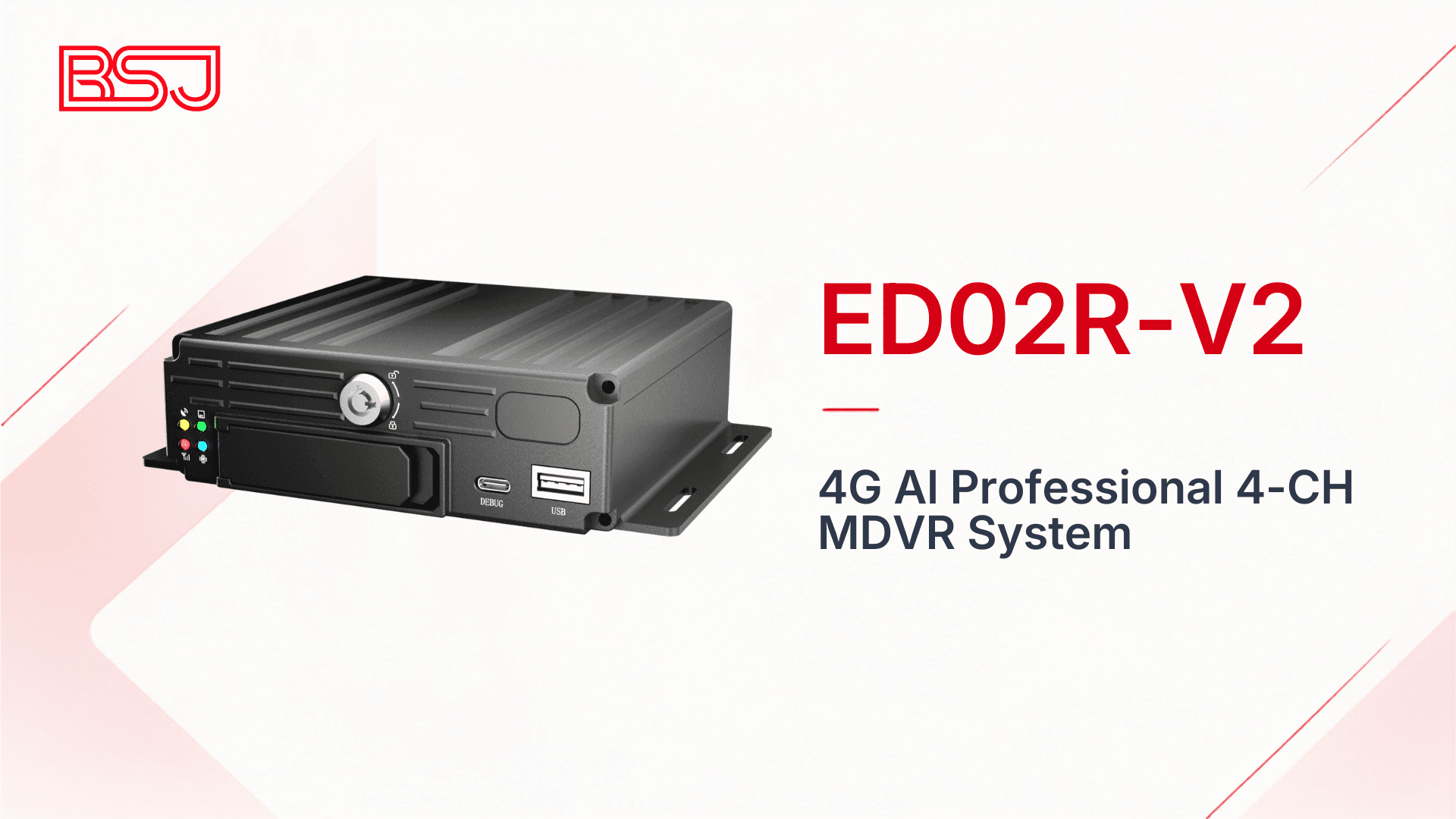
Our ED02R-V2 is a 4-CH AI-powered MDVR developed for commercial fleet applications. The official product page states that it supports 4-channel 1080P or 720P video collection, together with real-time uploads, playback, and access to historical video. It also integrates ADAS, DMS, and BSD within the MDVR platform.
The 1080P or 720P option gives buyers flexibility when matching camera resolution to the application. A fleet does not necessarily need every camera to perform the same role, so configuration can be planned around visibility requirements, available bandwidth, storage considerations, and the type of footage that needs to be reviewed.
A mobile dvr for vehicles is most useful when its recorded information can fit into the broader fleet workflow. Onboard recording provides a reference for incidents and operational reviews, while network connectivity can extend access beyond the vehicle itself.
The ED02R-V2 supports real-time video uploads as well as historical playback. This can be relevant for fleet teams that need to check an event while a vehicle remains in service. Remote access requirements will depend on the communication network, platform, and deployment configuration, so these elements should be considered together when selecting equipment.
Video recording answers one question: what was visible? AI functions can add another layer by identifying conditions or behaviors that deserve attention. The ED02R-V2 integrates ADAS, DMS, and BSD into the same MDVR architecture. BSJ describes BSD as using multi-angle AI vision to detect nearby vehicles, cyclists, and pedestrians in blind zones, while ADAS and DMS address driving assistance and driver monitoring.
For a bus operator, DMS can support monitoring of driver-related behavior, while multiple camera views provide surrounding context. For larger commercial vehicles, BSD can help monitor blind-zone situations around the vehicle. These functions form part of a technology-assisted safety and monitoring system rather than replacing the driver’s responsibility.
When selecting a mobile dvr for vehicles, buyers should look beyond the recorder itself. Camera compatibility, installation space, wiring, network availability, storage, software compatibility, and future maintenance can all affect the practical result.
BSJ uses a device ecosystem approach that includes trackers, dashcams, and MDVRs. Our BSJ Configurator supports parameter setup, while FOTA Web supports remote firmware updates and fleet-wide device management. The BSJ Monitoring System also combines live video monitoring, GPS tracking, event playback, and fleet-status information.
Video and location data answer different operational questions. Cameras show what happened around the vehicle, while GPS tracking provides location and route information. Combining these sources can give fleet managers a more useful operational picture.
For example, an operator reviewing a traffic incident may need both the relevant video and the vehicle’s location history. Our GPS tracker portfolio can therefore complement an MDVR deployment when a customer needs both video and positioning capabilities. BSJ currently offers several GPS tracking products, including wired and wireless models for vehicle and asset monitoring.
We design our products for commercial fleet environments where video, location, and device management may need to work together. BSJ/BSJ Technology currently provides AI dashcams, MDVR systems, GPS trackers, AI cameras, and fleet telematics tools, with applications spanning logistics, public transportation, construction, mining, and other commercial operations.
The right combination depends on the vehicle and operating environment. A bus fleet may place greater emphasis on passenger-area coverage and driver monitoring, while a logistics operator may prioritize road-facing video and broader external visibility.
Before specifying a four-channel MDVR, we recommend reviewing several practical points:
A specification that looks strong on paper still needs to match the vehicle’s physical and operational environment.
A 4 channel vehicle dvr can provide a useful balance for trucks and buses that need broader video coverage without moving immediately to a higher-channel recorder. The ED02R-V2 combines four-channel 1080P or 720P video collection with real-time uploads, playback, ADAS, DMS, and BSD, bringing several functions into one vehicle device.
For fleet operators, the best approach is to define the required camera views and management workflow first, then select the hardware around those needs. A mobile dvr for vehicles becomes more valuable when its video capabilities, AI functions, connectivity, and wider fleet platform are considered as one system.
At BSJ Technology continues to develop its AI video telematics and Fleet IoT portfolio, we focus on hardware that can fit different commercial fleet architectures and integrate into broader management environments.

BSJ Technology (SZSE: 301608) is a global provider of AI Video Telematics and Connected Fleet IoT solutions. Since 2009, BSJ has developed AI Dashcams, MDVR systems, and GPS tracking solutions for commercial fleets worldwide.