Choose your operating system to start
A large commercial vehicle can present several safety risks at once. The driver must monitor the road ahead, remain attentive, and account for vehicles, cyclists, and pedestrians around the sides of the vehicle. A forward-facing camera alone cannot provide visibility into every direction or explain every driving event.
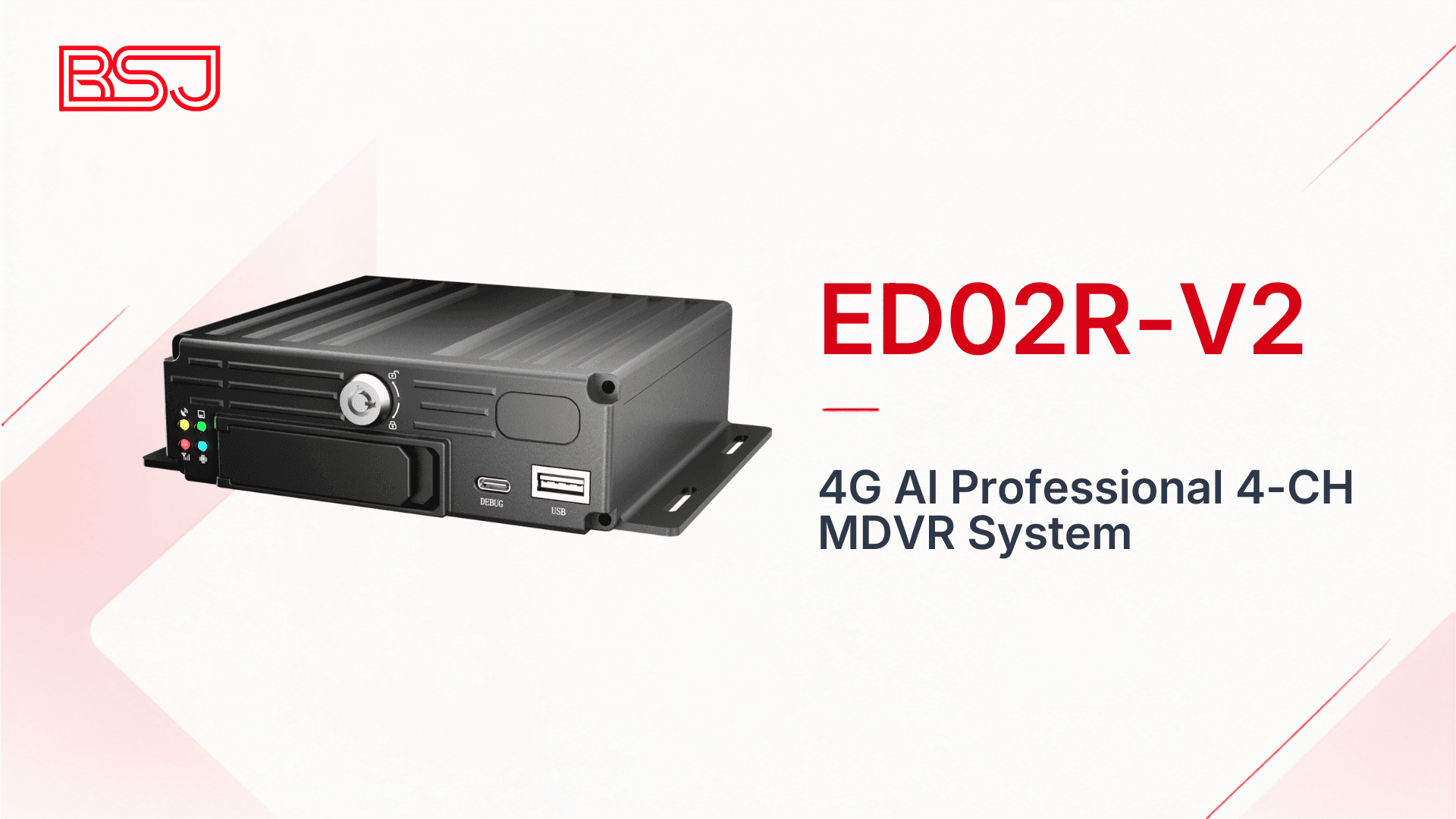
A multi-camera mobile digital video recorder (MDVR) addresses this challenge by combining onboard video collection with intelligent safety functions. At BSJ Technology, we develop vehicle telematics hardware for commercial fleets that need more comprehensive visual coverage, event recording, and integration with fleet monitoring systems.
Heavy trucks, buses, construction vehicles, and other commercial vehicles have different visibility requirements. Vehicle dimensions, cab design, turning movements, and operating environments can create areas where drivers have limited direct visibility.
A single camera may document the road ahead but leave other relevant areas unrecorded. A 4G AI MDVR can combine multi-channel video recording with supported AI safety functions, giving fleet operators more information for incident investigation and driver supervision.
The value comes from matching camera positions and detection functions to actual risks. More cameras do not automatically guarantee safer operations; coverage, installation, configuration, and driver response all influence the result.
A 4 channel AI MDVR supports video collection from multiple camera positions, allowing fleet operators to configure views around their vehicle and operational requirements. The ED02R-V2 from BSJ Technology supports four-channel HD video collection at 1080P or 720P, with real-time uploads, playback, and access to historical video.
Possible camera positions include the forward road view, driver cabin, vehicle sides, and rear area. The final arrangement should reflect the vehicle's design and the events the fleet needs to observe. A bus operator, for example, may prioritize passenger-area visibility, while a heavy truck operator may place greater emphasis on side and rear blind zones.
Camera selection also affects installation complexity and the usefulness of recorded footage. Integrators should verify supported camera types, image resolution, mounting positions, wiring routes, and environmental suitability before finalizing the configuration.
Video recording documents events, but AI detection can help identify selected risks while a vehicle is operating. The ED02R-V2 combines three distinct safety functions: Advanced Driver Assistance Systems (ADAS), Driver Monitoring Systems (DMS), and Blind Spot Detection (BSD).
ADAS focuses on driving conditions ahead. Depending on the supported configuration, it can provide warnings associated with risks such as lane departure, forward collision, or insufficient following distance. These alerts give drivers an opportunity to respond to detected hazards.
DMS focuses on driver behavior. Supported monitoring functions can identify selected indicators of fatigue or distraction. Fleet supervisors can use relevant alerts and recorded events to investigate recurring concerns and guide driver training.
BSD focuses on areas around the vehicle. Multi-angle AI vision can detect nearby vehicles, cyclists, and pedestrians in monitored blind zones. This is particularly relevant to large vehicles performing turns, lane changes, or low-speed maneuvers.
A 4G AI MDVR brings these functions into a combined onboard system, but detection depends on the installed cameras, configuration, operating conditions, and supported algorithms. Alerts assist drivers; they do not replace mirrors, direct observation, or safe driving procedures.
A recorded event is most useful when authorized personnel can retrieve it and understand its context. Real-time uploads can make selected video available remotely, while playback and historical-video access support subsequent investigations. Actual availability depends on connectivity, recording settings, and the deployed platform.
The ED02R-V2 also supports BSJ Configurator and FOTA Web for parameter configuration and remote firmware upgrades. These functions can help administrators manage device settings and updates across distributed fleets without treating every configuration change as an individual manual task.
For platform providers and system integrators, the hardware-to-software connection deserves careful attention. Confirm how event notifications, vehicle identifiers, timestamps, and video retrieval are handled by the target platform. A 4 channel AI MDVR should fit the intended monitoring workflow rather than operate as an isolated recording device.
Selecting equipment begins with the vehicle's operational profile. Logistics fleets may prioritize forward-road monitoring and blind-spot visibility, while public transportation operators may need additional cabin coverage. Construction fleets can have different camera placement requirements because of vehicle geometry and working conditions.
Buyers should document the required views, AI functions, video resolution, upload expectations, storage needs, and integration arrangements. A pilot installation can then reveal coverage gaps, cabling difficulties, and alert-handling issues before a larger deployment.
OEM/ODM customers may also need customized hardware configurations or integration support for their own telematics platforms. At BSJ Technology, our focus is vehicle telematics hardware and connected fleet solutions, supporting B2B partners that need to align equipment with specific vehicle applications.
A 4G AI MDVR should be selected according to the safety events a fleet needs to detect, document, and review. The ED02R-V2 combines four-channel HD video recording with ADAS, DMS, and BSD capabilities, providing a hardware foundation for multi-angle fleet safety monitoring. Correct camera placement, suitable configuration, and a workable review process determine how effectively that capability serves real-world fleet operations.

BSJ Technology (SZSE: 301608) is a global provider of AI Video Telematics and Connected Fleet IoT solutions. Since 2009, BSJ has developed AI Dashcams, MDVR systems, and GPS tracking solutions for commercial fleets worldwide.