Choose your operating system to start
A 3-channel dashcam can provide a practical middle ground between a simple forward recorder and a larger multi-camera video system. Three views are often enough to combine road evidence, driver or cabin context, and one additional external or cargo-related angle. For commercial buyers, however, the value depends on how those channels support real safety, claims, service, or security workflows. The purchasing decision should also account for the device as a connected fleet endpoint.
A 3-channel dash cam may need 4G communication, positioning, AI event detection, remote configuration, and platform integration in addition to recording. Defining those requirements before installation helps prevent a project from collecting footage that cannot be retrieved or managed efficiently when the fleet grows.
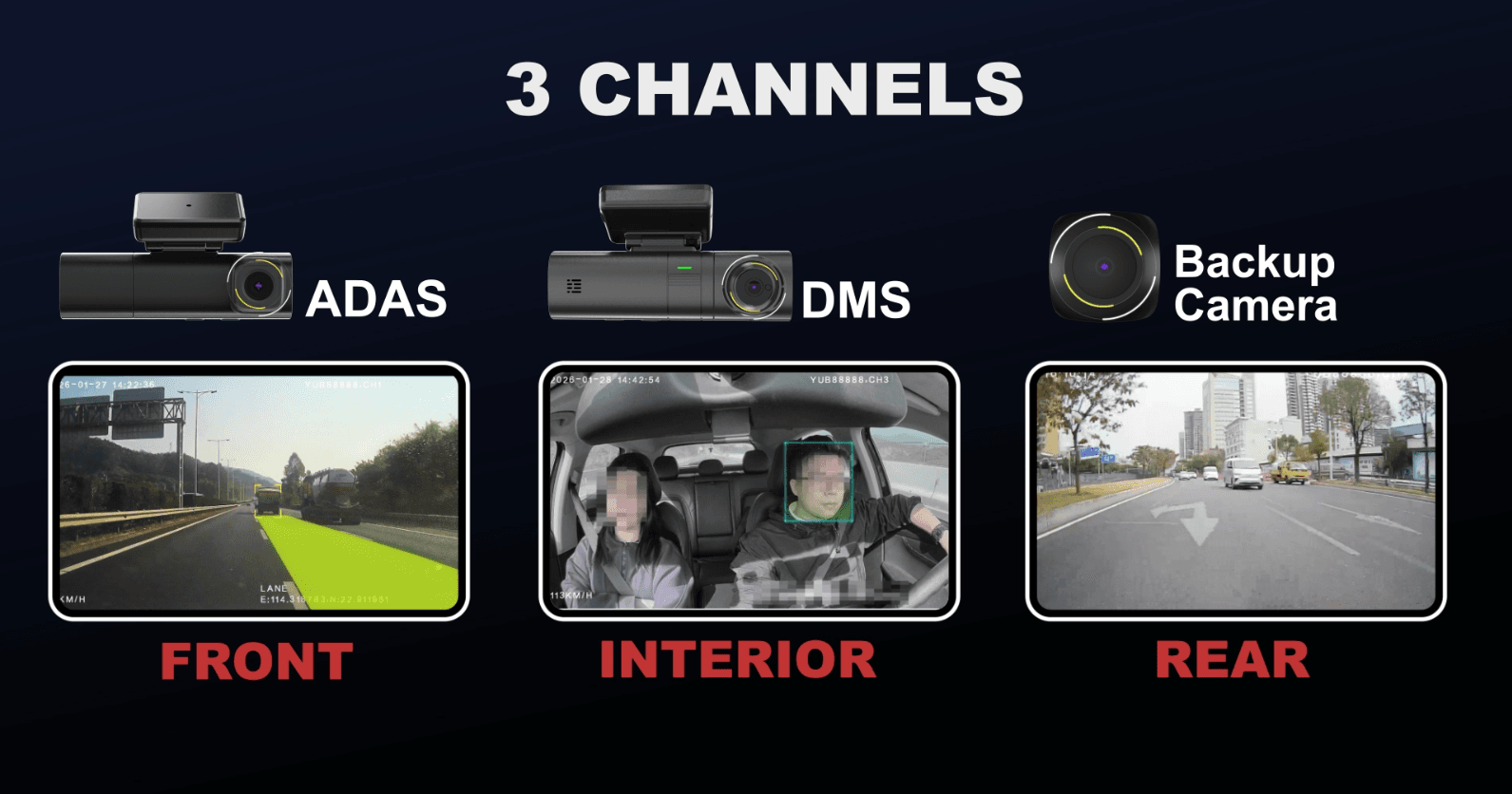
The first design task is to decide what the third view must accomplish. Logistics fleets may use it for cargo or a side door, buses may prioritize the passenger area, taxis may need cabin context, and heavy vehicles may use it for a blind zone. Camera position should be validated from the driver's seat and from recorded footage so the installation does not obstruct visibility or leave the important area outside the frame.
The DR03 in our portfolio is a three-channel HD dashcam based on Linux with a 1.0 TOPS AI NPU. It can combine a forward road view, driver or cabin coverage, and an optional external channel. That architecture can support varied commercial-vehicle programs, but buyers should still confirm the exact channel configuration, camera compatibility, and recording behavior required for their selected model and market. Power compatibility is a practical fleet issue.
For vehicle power compatibility, our DR03 uses a 9-90V input range, which can support different commercial vehicle classes, but installation teams still need to account for ignition logic, fuse protection, parking behavior, and battery protection. The acceptance procedure should verify clean startup, controlled shutdown, and stable recording after common power events instead of relying only on the nominal voltage range. Image evidence should be tested under actual route conditions.
Night driving, windshield reflections, backlighting, rain, vibration, and cabin lighting can change what a camera records. A fleet that expects footage to support insurance or safety review should evaluate whether the relevant objects and behaviors remain interpretable at the distances and lighting conditions that matter to the business.
AI functions can make a compact device more useful when events are actionable. Within the AI layer, our DR03 supports ADAS functions for collision risk, lane departure, and following distance, together with DMS functions for fatigue and distraction. A buyer should connect each event type to a review or coaching process and decide which warnings remain local to the driver and which are transmitted to the control room.
In our device-management work at BSJ Technology, we reduce variation after installation. Remote configuration and FOTA capability can help teams manage settings and firmware without physically collecting every unit. Before rollout, customers should test permissions, batch updates, AI parameter control, and recovery procedures so remote changes remain traceable across different depots, contractors, or regions. Connectivity and positioning add context to video.
For connectivity, our DR03 uses 4G LTE CAT.4 and supports GPS, Galileo, BeiDou, and GLONASS. These functions can associate an event with time and place and support selected remote video workflows. The project still needs a bandwidth policy so critical clips move quickly without turning continuous video transmission into an uncontrolled operating cost. Integration should be verified early if the 3-channel dashcam will feed an existing fleet platform.
Vehicle IDs, event codes, GPS data, thumbnails, video requests, and device status need consistent mapping. A distributor or system integrator may prefer to preserve its established software and customer accounts, making protocol stability and engineering support more important than a separate branded application.
A scalable installation package includes more than the camera itself. Mounting location, cable routing, antenna placement, storage media, network settings, firmware version, and commissioning results should be recorded for each vehicle class. This gives field technicians a standard to follow and allows support teams to distinguish hardware faults from differences created by inconsistent installation practices. Driver communication is also part of maintainability.
Fleets should explain which cameras operate, which AI events are monitored, how alerts are reviewed, and who can access video. Clear policies can reduce resistance and help supervisors use the system for safety and incident management rather than allow the technology to become an undefined surveillance tool with inconsistent local practices.
Commercial buyers can evaluate our hardware engineering and OEM/ODM flexibility when their 3-channel dash cam project requires custom accessories, firmware development, branding, or platform adaptation. Those requests should be captured in a controlled specification and tested during the pilot, because undocumented changes are difficult to reproduce once orders expand across multiple production batches. A three-view camera earns its place when every channel answers a different operational question.
For three-channel projects, our team at BSJ Technology combines road, cabin, and optional external coverage with AI events, GNSS, connectivity, remote configuration, and a controlled installation process. A 3-channel dash cam should be validated on the actual vehicle because windshield geometry, cable routes, lighting, and power behavior can change the usefulness of the same hardware.
We also expect buyers to test alert handling and platform integration rather than judging the camera only from recorded clips. With a clear camera plan and reproducible device profile, fleets can use three synchronized views as evidence for safety and incident workflows without turning additional channels into unnecessary storage and review work.

BSJ Technology (SZSE: 301608) is a global provider of AI Video Telematics and Connected Fleet IoT solutions. Since 2009, BSJ has developed AI Dashcams, MDVR systems, and GPS tracking solutions for commercial fleets worldwide.